How the complete treatment train works
Water passes through a chamber where the system exposes it to UV. A lamp is commonly separated from the water by a quartz sleeve. The complete device includes the reactor and its controls; the lamp alone does not establish treatment performance.
Pretreatment comes before the UV stage when required. A sediment filter, additional contaminant-specific treatment or other equipment may be necessary. The example below is not a prescription for every source.
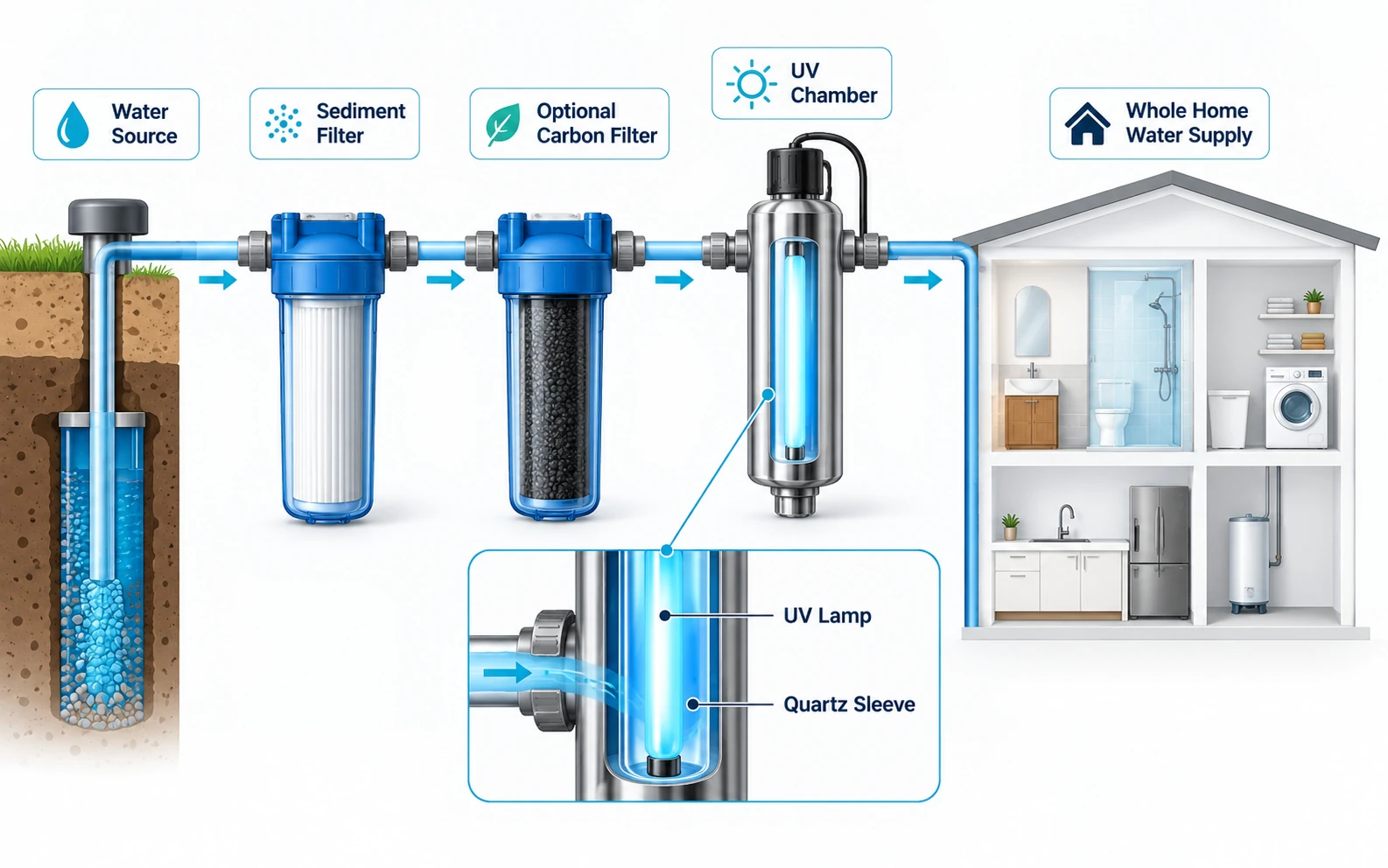
Choose and compare a system
Move from understanding the technology to comparing a documented design. Start with the buying guide, then resolve the sizing, features and service questions for your application.
How to Size a UV Water Treatment System
Use peak flow, fixture demand, UV dose and tested water quality to compare UV system capacity, with a practical homeowner information worksheet.
Read the guideUV Water System Buying Guide: What to Look For Before You Buy
Compare UV water systems by supported flow and dose, tested water quality, pretreatment, monitoring, certification, service access and replacement costs.
Read the guideUV Water System Flow Rate: 6, 8, 10, 12 and 15 GPM Explained
Understand 6, 8, 10, 12 and 15 GPM UV water ratings, peak demand, dose conditions, pressure loss and capacity margin without universal household rules.
Read the guideWhat Size UV Water System Do I Need for My Home?
Build a home UV sizing brief from occupants, bathrooms, simultaneous fixtures, measured flow, pump capability, water quality and rated treatment conditions.
Read the guideDo You Need a UV Intensity Sensor on a Water Treatment System?
Understand UV intensity sensors, lamp-failure alarms, fouling, water-quality changes and fault response when comparing monitored water systems.
Read the guideUV Water System Lamp and Maintenance Costs
Compare UV water lamp, sleeve, O-ring, filter, sensor, electricity and service costs using real part quotes and a clear long-term maintenance budget.
Read the guideVerify the certification and its intended use
Check the exact model’s certified claims and operating limits. NSF distinguishes NSF/ANSI 55 Class A systems for treating microbiologically contaminated water from Class B systems intended for supplemental treatment of disinfected drinking water. A Class B claim should not be treated as equivalent to Class A.
Verify the current listing with the certifier and ask whether the classification is suitable for your source. A certification mark is not a claim that the system removes all chemicals or treats water outside its specified conditions. Read NSF’s explanation of the standards.
Explore the water-treatment guides
Well Water
Whole House
How UV Works
Installation
Maintenance
UV vs Reverse Osmosis
UV vs Chlorine
UV vs Filtration
Best Systems
Match the system to tested water quality
| Item to evaluate | Why it belongs in the assessment |
|---|---|
| Microbiological test results | Establish the concern and the need for disinfection |
| Sediment and turbidity | Particles and cloudiness can interfere with exposure |
| UV transmittance, if specified | Indicates how well the water transmits the relevant UV |
| Iron, manganese and hardness | May require treatment to meet equipment limits and control deposits |
| Chemical contaminants | Need their own verified treatment approach |
| Peak service flow | Must stay within the unit’s supported treatment conditions |
Use an appropriate laboratory and the relevant drinking-water authority for advice on testing. The manufacturer’s water-quality limits should be available before a system is purchased, not discovered after installation.
Size for peak use, not daily volume alone
A household can use several fixtures at once. A system must be evaluated for the peak flow it is expected to treat under the specified water conditions. Daily gallons do not describe that momentary demand.
Ask what happens if flow exceeds the supported limit or if UV intensity is inadequate. The answer depends on the actual controls and any shutoff arrangement. Do not assume that every unit prevents untreated water from passing through.
Plan for maintenance and interruptions
The lamp, sleeve, sensor where fitted and controller have different service needs. A lamp can remain visibly lit while no longer meeting its useful service specification. Deposits on the sleeve also require attention according to the manual.
Loss of power or a treatment fault needs a documented response. UV does not leave a continuing disinfectant residual in downstream plumbing. Ask the installer about commissioning, downstream sanitation and what to do after an interruption before relying on the system.
UV, filtration and reverse osmosis
These are different treatment tools. A filter or membrane should be selected for the contaminants it is documented to reduce; UV addresses a disinfection objective. A combined system can be appropriate, but a larger collection of devices is not automatically a better design.
The term “purification” can imply more than a product provides. Ask for specific reduction claims and operating limits instead. The intended outcome should be defined by the water test, not by a broad product label.
Questions People Ask Next
Does UV make any water safe to drink?
No. UV is not a universal treatment for chemical contamination or water outside the equipment’s supported quality limits. Select treatment based on testing and relevant authority guidance. A working lamp alone does not establish that every contaminant has been addressed or that downstream plumbing is free from contamination.
Is a filter needed before UV?
Pretreatment requirements depend on the water and the unit’s operating specifications. Particles and deposits can interfere with treatment, so prefiltration or additional conditioning may be required. Do not copy a generic filter sequence without checking your test results and the exact UV system’s water-quality limits.
Can UV replace reverse osmosis?
Not where reverse osmosis is being used to reduce a contaminant that UV does not remove. The two technologies have different purposes. Identify the contaminant and review the specific system’s documented reduction claims. A treatment professional can help determine whether one, both or a different approach is appropriate.
What happens during a power outage?
Treatment cannot be assumed when a powered UV system is not operating. Whether water stops flowing depends on the installed controls. Have a clear alternative-water and restart plan before an outage. Follow local authority advice and the manufacturer’s instructions rather than assuming normal-looking water is adequately treated.
How do I know a system fits my home?
Compare tested water quality and peak fixture demand with the manufacturer’s supported conditions. Check pretreatment, alarm behavior, shutoff options, installation access and recurring service needs. The whole-house guide explains the arrangement, while the well-water guide focuses on the source assessment and documentation needed before selecting equipment.
Sources & further reading
Primary references for the principles discussed. Manufacturer instructions take precedence for a specific system; no independent technical reviewer is claimed.