Point-of-entry versus point-of-use treatment
A whole-house UV water system is a point-of-entry arrangement intended to treat the supply serving most or all household fixtures. A point-of-use unit treats water at a specific outlet. A UV water purifier at one drinking tap should not be described as treatment for the entire home.
The phrase “whole-house purifier” does not establish removal of every contaminant. Document which branches are treated, the microbial objective and the purpose of any additional stages. UV remains a disinfection process, even when installed for the entire home.
| Arrangement | Scope to confirm |
|---|---|
| Point of entry | Which household branches pass through the treatment train |
| Point of use | Which tap or appliance receives treatment |
| Combined arrangement | Why each stage is needed and how downstream storage is protected |
Read the treatment train from source to home
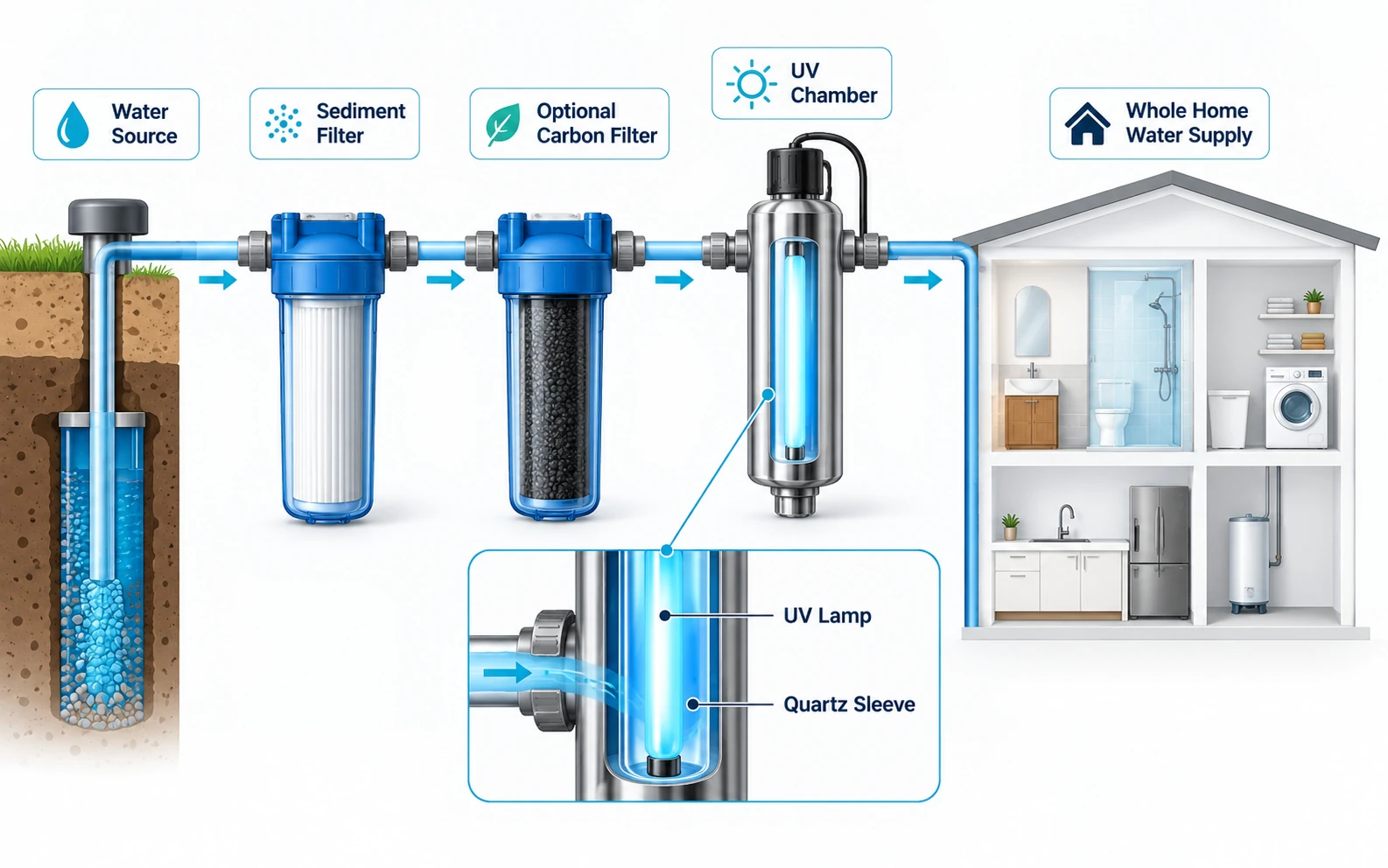
The example below shows a source, sediment filter, optional carbon treatment and UV chamber. Real installations may require different or additional stages. Follow the manufacturer’s orientation, spacing and service requirements rather than treating the diagram as a plumbing plan.
Identify which fixtures the treatment is intended to serve. Outdoor connections, storage and other branches can change the layout. A professional should confirm that the piping arrangement does not allow untreated water to be mistaken for treated water.
Match flow and water quality together
A reactor’s supported flow assumes specified operating conditions. Check peak demand and the incoming water-quality limits together. A high advertised flow rating does not establish the appropriate treatment capacity for every source.
Account for the flow characteristics of upstream equipment as well. Compare the complete system’s pressure and service requirements rather than selecting each component in isolation.
Plan an accessible equipment location
| Design consideration | Question to resolve |
|---|---|
| Lamp removal | Is there enough clearance for the full lamp and sleeve? |
| Electrical supply | Does the location meet the product’s supply and environmental requirements? |
| Leak and service access | Can the chamber and upstream equipment be isolated and serviced as directed? |
| Fault protection | What do alarms and any shutoff devices actually do? |
| Bypass arrangements | How will untreated flow be controlled and clearly identified? |
| Handover | Who documents startup, maintenance and restart procedures? |
Understand the downstream limitation
UV does not maintain a disinfectant residual throughout the household pipework. Startup, plumbing work or a treatment interruption can raise separate questions about downstream sanitation. Ask the installer for a documented procedure appropriate to the equipment and water supply.
Do not assume that a control-panel light proves water quality at every tap. The system’s indicators, supported conditions, maintenance records and testing all provide different information.
Budget for the system rather than the chamber
Include pretreatment, plumbing, electrical requirements, commissioning, replacement lamps, filter consumables and service in a quote. A chamber-only price is not a complete installation budget. Ask each supplier to identify assumptions and exclusions.
For a well supply, read UV for well water first. For recurring service, use lamp and maintenance guidance and keep the water-treatment manuals together.
Use the water cluster to finalize the plan
Establish peak treated flow before choosing a chamber. Review installation and bypass considerations, lamp and sleeve maintenance and complete ownership cost together. If a dissolved contaminant needs separate treatment, compare UV and reverse osmosis rather than relying on the whole-house label.
Choosing a UV System: What Actually Matters
After resolving this page’s technical question, compare the following requirements for your installation. The water system buying guide brings the full specification record together.
| Criterion | What to verify |
|---|---|
| Flow, UV dose and water quality | Compare rated flow at the documented dose, UV transmittance and lamp-life condition. Include peak simultaneous demand. |
| Chamber and installation | Check material, pressure/temperature limits, mounting orientation and lamp/sleeve removal clearance. |
| UV intensity sensor and alarms | Distinguish intensity monitoring, lamp-failure detection, reminders and an actual automatic shutoff. |
| Lamps, sleeves and seals | Verify part numbers, lamp-life rating, service intervals, replacement prices and parts availability. |
Questions People Ask Next
Is a whole-house UV system a filter?
The UV chamber is a disinfection stage, not a particle-removal filter. A whole-house package may include separate filters or other treatment, so identify each component and its purpose. The phrase “UV filter” can obscure this difference. Check the documented reduction claims for the complete arrangement.
Does UV go before or after a carbon filter?
The sequence must follow the equipment design and water assessment. Necessary pretreatment generally occurs before the UV stage so the reactor receives water within its supported conditions. The illustration shows optional carbon before UV, but it is not a universal prescription. Ask the installer to justify the actual order.
Can a system serve several bathrooms?
Potentially, but bathroom count alone is not a treatment specification. Evaluate simultaneous fixture demand and the supported flow under the actual water conditions. Ask how excess flow is prevented or addressed. A system selected only by household size may miss the peak-use condition that matters to reactor performance.
Can I bypass UV during maintenance?
Any bypass needs a clearly documented procedure that prevents untreated water from being assumed safe for normal use. Follow the installer’s instructions and relevant drinking-water advice. Do not treat a bypass valve as a reason to ignore treatment interruptions; plan an appropriate alternative supply and restart process.
What should be included in the handover?
Keep the piping layout, model and lamp details, commissioning record, manuals, maintenance schedule and fault-response instructions. Ask who is responsible for downstream sanitation and future service. The owner should understand what each indicator means and whether a fault automatically stops water or merely raises an alert.
Sources & further reading
Primary references for the principles discussed. Manufacturer instructions take precedence for a specific system; no independent technical reviewer is claimed.