Choose a focused comparison
Coil UV vs airstream UV
Compare targets, dose and evidence.
Read the guideHVAC UV vs air purifier
Separate UV, HEPA, carbon and electronic processes.
Read the guideUV vs HVAC filter
Understand particle capture and complementary roles.
Read the guideUV vs reverse osmosis
Compare disinfection and membrane separation.
Read the guideUV vs chlorine
Compare contact, residual and operating needs.
Read the guideUV vs water filtration
Identify the purpose of each treatment stage.
Read the guideUV versus an air purifier or HEPA filter
| Technology | Intended role | Questions to ask |
|---|---|---|
| Coil UV | Treatment of irradiated HVAC surfaces | What receives the light, and what remains shadowed? |
| Airstream UV | Treatment in an engineered exposure zone | Does the evidence match airflow and operating conditions? |
| HEPA / particle air cleaner | Capture of particles passing through the device | Is the airflow and capacity suitable for the room or system? |
| Ionization and combined processes | Product-specific air-treatment mechanisms | What independent performance and emissions evidence exists? |
“Air purifier” is a broad product label, not a single technology. A device can combine a filter and UV, so the comparison is not always either/or. Evaluate each claimed function and confirm the complete device’s operating requirements.
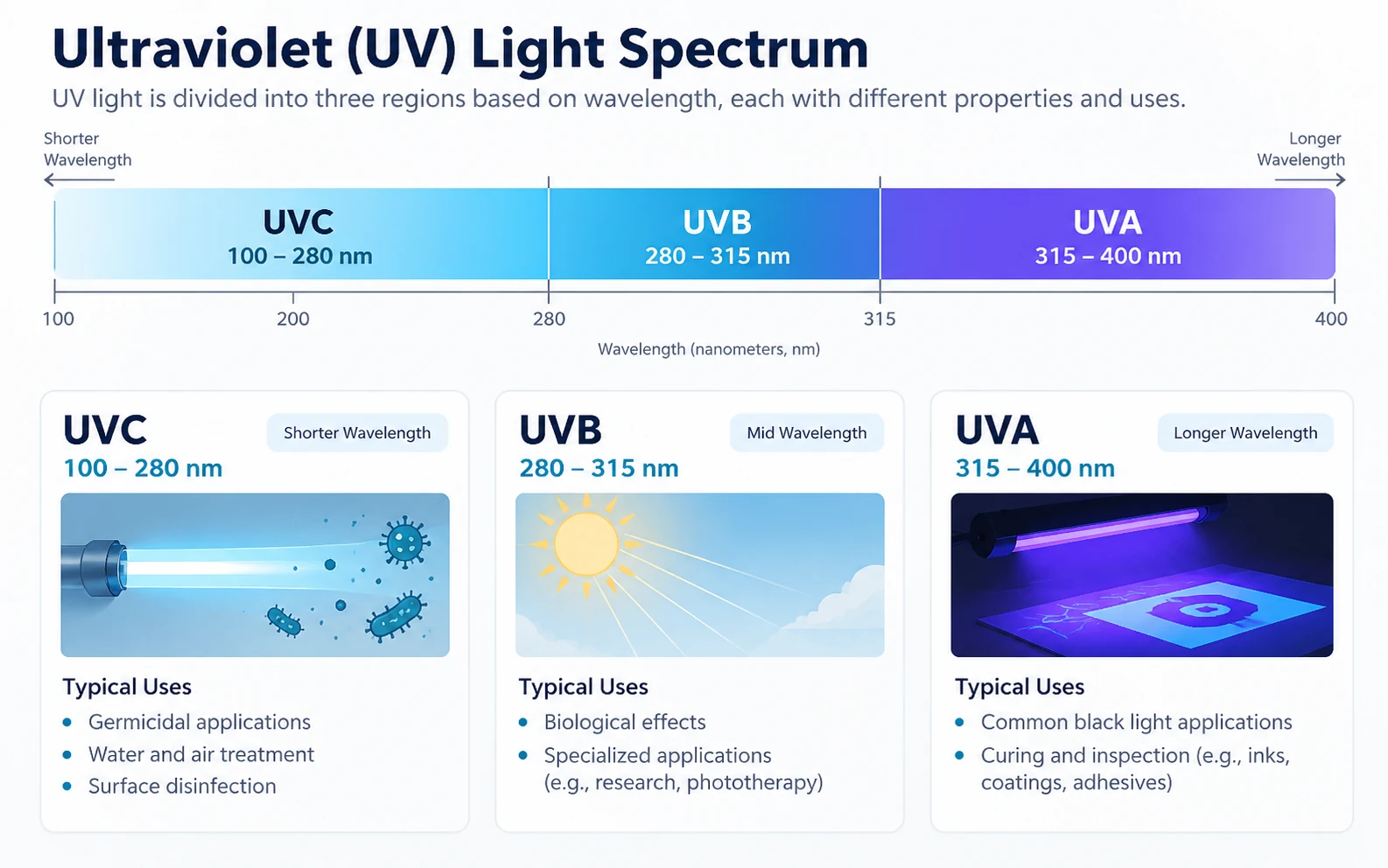
UVA, UVB and UVC
These names identify different wavelength bands. A decorative black light is not interchangeable with a specified germicidal lamp. The supplied spectrum diagram is a category overview; it is not a calibrated scale or a product-selection chart. Wavelength conventions may differ at the boundary between UVA and UVB.
UV versus water filtration and reverse osmosis
Choose water treatment from test results and documented contaminant-reduction claims. A UV reactor does not remove dissolved chemicals or salts. Filters and membranes have their own capabilities and limitations, so verify the exact system rather than treating the technology name as a complete performance claim.
A whole-house treatment train may use several stages. Each should have a clear purpose, compatible operating conditions and a maintenance plan. See UV water treatment for how pretreatment fits.
A decision framework
- Name the concern: coil growth, particles, a tested water contaminant or something else.
- Check what the device actually treats or removes.
- Compare documented conditions with the intended installation.
- Evaluate emissions, exposure protection and fault behavior.
- Budget for maintenance over the same ownership period.
Compare system characteristics before products
Single vs dual lamp
Compare coverage, fit and service requirements.
Read the guide24V vs 120V
Compare supply compatibility without assuming a performance advantage.
Read the guideCompare water flow ratings
Understand the conditions behind GPM.
Read the guideCompare monitoring features
Distinguish indicators, sensors, alarms and shutoff.
Read the guideQuestions People Ask Next
Is UV better than HEPA?
Neither is universally better because they serve different purposes. HEPA filtration captures particles passing through a suitable device, while UV treatment depends on radiation reaching its target. For an HVAC coil issue, a particle air cleaner is not the same intervention. For airborne dust, a UV lamp does not provide particle capture.
Does an ionizer work like UV?
No. The treatment mechanism is different, and product-specific performance and emissions should be evaluated separately. Some devices combine technologies, which makes the complete system’s documentation especially important. Do not use the presence of a UV lamp as evidence for the claims of another process bundled into the product.
Can UVA replace a UVC lamp?
Do not substitute wavelength categories in a system designed for a specified lamp. A compatible replacement must meet the manufacturer’s requirements, including the intended radiation and electrical characteristics. A black light that fits physically does not establish germicidal performance. Follow the original system documentation or obtain a supported substitution.
Why do UV wavelength charts differ?
Some sources use different boundary conventions, particularly for UVA and UVB. The supplied chart uses 315 nm, while the linked FDA overview uses 320 nm. This difference does not make a consumer lamp interchangeable with a specified treatment source. Select equipment by its actual documented design and application.
Can one system treat air and drinking water?
Do not assume so. An HVAC accessory and a drinking-water reactor have different construction, exposure conditions and safety requirements. Use equipment designed and supported for the actual application. A shared reference to UV-C does not establish that a product can be transferred between air and water treatment.
Sources & further reading
Primary references for the principles discussed. Manufacturer instructions take precedence for a specific system; no independent technical reviewer is claimed.