When UV is appropriate for well water
UV can be appropriate when an assessed microbial concern can be addressed by a suitable reactor and the water meets its pretreatment and flow conditions. It should be part of a documented response to the source, not a reason to ignore a well defect or other contaminants.
If a test identifies unsafe water, follow the local health authority’s instructions for immediate use and an alternative supply. Installing equipment is not, by itself, verification that the water is suitable to drink.
Test before buying equipment
Ask an appropriate laboratory or local authority which tests are relevant to your well and location. Keep the report, sampling date and any source history together. A seller’s generic package cannot replace an assessment of what the water contains.
If a test identifies a problem, discuss the well itself and possible contamination pathways as well as treatment. An appliance should not be used to ignore a defect in the source or an urgent drinking-water advisory.
Verify the certification and its intended use
Check the exact model’s certified claims and operating limits. NSF distinguishes NSF/ANSI 55 Class A systems for treating microbiologically contaminated water from Class B systems intended for supplemental treatment of disinfected drinking water. A Class B claim should not be treated as equivalent to Class A.
Verify the current listing with the certifier and ask whether the classification is suitable for your source. A certification mark is not a claim that the system removes all chemicals or treats water outside its specified conditions. Read NSF’s explanation of the standards.
Coliform bacteria and E. coli results
Total coliform testing provides an indicator of water quality and possible pathways for contamination. E. coli or fecal-coliform findings more specifically indicate fecal contamination concerns. The result should be interpreted with the laboratory and local health authority; do not treat all coliform results as equivalent.
Keep untreated-source and treated-outlet results clearly identified. The bacteria and UV guide explains dose dependence, follow-up testing and why contamination can occur after treatment.
Sediment, iron, manganese, hardness and turbidity
| Parameter | Role in the treatment assessment |
|---|---|
| Sediment | Particles may require removal before UV exposure |
| Turbidity | Cloudiness can signal conditions affecting exposure; check the specified limit |
| Iron and manganese | Can influence deposits and pretreatment requirements; UV does not remove them |
| Hardness | May contribute to sleeve fouling; conditioning depends on tested levels and equipment |
| UV transmittance | Describes transmission of the relevant UV through water; not the same as turbidity |
| Chemical contaminants | Need their own documented treatment, independent of microbial disinfection |
Use measured results and the actual manufacturer’s limits rather than universal water-quality thresholds. Clear appearance and taste cannot replace testing.
Build pretreatment around the results
Compare the report with the UV manufacturer’s limits. Sediment, cloudiness and dissolved constituents that affect transmission or form deposits may require specific treatment. Iron, manganese and hardness can influence the pretreatment discussion; the correct response depends on measured levels and the equipment.
An optional carbon filter in a diagram does not mean carbon resolves all chemical concerns. Choose treatment with an appropriate documented reduction claim and maintain that stage as well as the UV reactor.
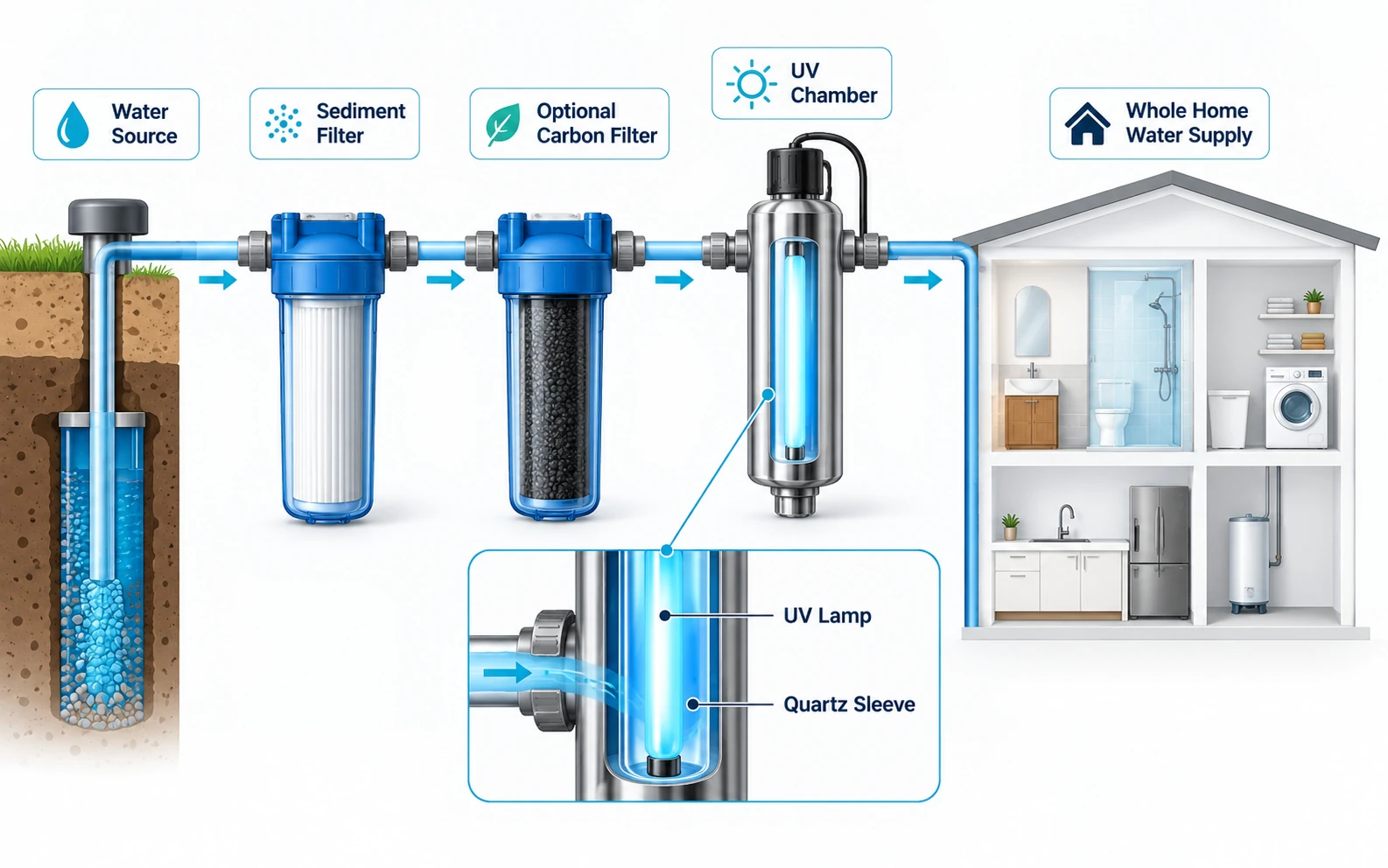
Check the busiest flow condition
Consider simultaneous use rather than only average daily consumption. Ask how the system will maintain its supported conditions at peak demand, and whether a flow-control device is part of the design. Compare the rated flow under the stated treatment conditions, not a marketing “maximum” without context.
Ask the installer to explain alarm behavior and whether the system shuts off water on a fault. An audible alert may be useful, but it is not the same as an automatic barrier to flow.
Prepare for faults, outages and restart
Keep a documented plan for alternative drinking water if treatment is interrupted. Follow applicable public-health advice for the actual contaminant; boiling is not a universal response to chemical contamination. The CDC emergency-water guidance is linked below.
Discuss commissioning and downstream plumbing sanitation with the installer. UV treatment does not establish a lasting residual throughout the household pipes. A repaired or restarted unit may require further steps before normal use resumes.
Maintain the whole system
- Replace the specified lamp on its documented schedule.
- Clean or service the quartz sleeve as directed.
- Maintain upstream filters and conditioning equipment.
- Respond to alarms using the manual, not by simply resetting them.
- Retain test reports, parts records and service dates.
Use the whole-house guide to discuss physical arrangement, and the maintenance guide to organize the service record. Ask your local authority about ongoing testing appropriate to the well.
Is UV enough for well water?
Sometimes, but only when the water-quality problem is primarily microbial and pretreatment requirements are satisfied. Even then, the source assessment, supported flow, maintenance, verification and downstream protection must be addressed.
UV does not remove dissolved chemicals, minerals or sediment. A well containing both a microbial concern and a chemical contaminant needs a plan for each. A powered lamp cannot establish the suitability of the complete supply.
Plan whole-house flow, service and any residual protection
Use the peak-flow sizing worksheet and UV water installation guide to evaluate the entire home’s supply. A point-of-entry UV system differs from treatment at one drinking tap.
Keep water-system maintenance and testing in the plan. Where storage or downstream protection is a concern, compare UV with controlled chlorination rather than assuming either process is sufficient for every layout.
Choosing a UV System: What Actually Matters
After resolving this page’s technical question, compare the following requirements for your installation. The water system buying guide brings the full specification record together.
| Criterion | What to verify |
|---|---|
| Application and tested water | Define point-of-entry or point-of-use treatment, the microbial objective and the required pretreatment. |
| Flow, UV dose and water quality | Compare rated flow at the documented dose, UV transmittance and lamp-life condition. Include peak simultaneous demand. |
| UV intensity sensor and alarms | Distinguish intensity monitoring, lamp-failure detection, reminders and an actual automatic shutoff. |
| Certification, warranty and documents | Verify the exact model, class, certified claims and exclusions; retain the current installation and service manual. |
Compare the flow rating after the water assessment
Use the UV water flow-rate guide to compare advertised capacity with supported dose and water-quality conditions. Then bring those results to the water buying guide.
Questions People Ask Next
Does clear well water need treatment?
Appearance alone cannot establish microbiological or chemical quality. Use appropriate tests and advice for the well and location. Treatment decisions should follow the results and source assessment, not whether the water looks clear or tastes acceptable. Retain the report so the proposed equipment can be compared with the actual conditions.
Will UV remove iron or manganese?
UV is not a removal process for those constituents. Their presence may also affect the suitability or maintenance of a UV installation. Compare measured levels with the manufacturer’s limits and discuss pretreatment with a qualified water professional. Do not assume that a UV chamber replaces iron treatment or other conditioning equipment.
Is a sediment filter enough pretreatment?
Sometimes additional treatment is needed; the answer depends on the test results and UV system requirements. A sediment filter does not address every dissolved constituent or every water-quality condition. Ask the supplier to explain how the complete treatment train brings the water within the reactor’s supported operating limits.
Can I use water while the alarm is sounding?
Follow the documented fault response and relevant drinking-water advice. An alarm can indicate that the system is outside its intended operating conditions, and normal-looking water is not evidence of adequate treatment. Have an alternative-water plan in place before a fault occurs, and identify the cause rather than repeatedly resetting the alarm.
Does installing UV end the need for well testing?
No. Treatment maintenance and water testing answer different questions. A service record does not establish the absence of every contaminant or a change in the source. Ask the local authority or laboratory about an appropriate ongoing testing plan, especially after relevant changes, incidents or work on the well system.
Sources & further reading
Primary references for the principles discussed. Manufacturer instructions take precedence for a specific system; no independent technical reviewer is claimed.
- CDC: About Home Water Treatment Systems
- CDC: How to Make Water Safe in an Emergency
- CDC: Guidelines for Testing Well Water
- CDC: About Water Disinfection with Chlorine and Chloramine
- VIQUA: UV System Maintenance (manufacturer guidance)
- VIQUA: Owner’s Manual—water chemistry and system requirements (PDF; model-specific)
- NSF: Standards for Water Treatment Systems