Point-of-entry location and pretreatment
A whole-house, or point-of-entry, installation treats the intended supply entering the household distribution. A point-of-use system serves a specific outlet. Map branches, storage, the water heater and any untreated connections before selecting the UV location.
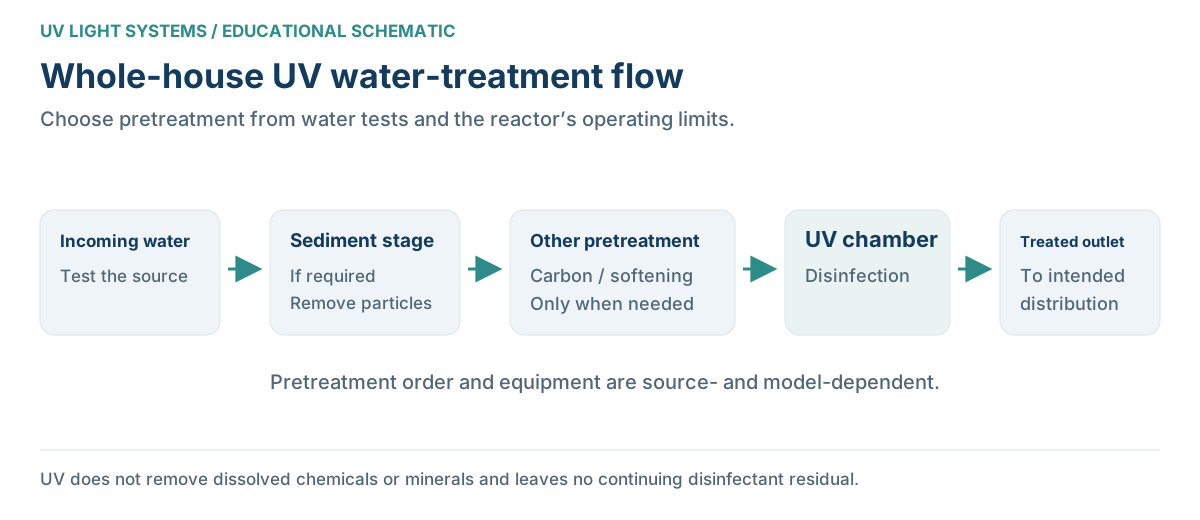
Necessary upstream treatment should bring water within the reactor’s requirements. Carbon, softening and sediment filtration have different functions. Their order and need come from the water assessment and the equipment, not from copying a generic package.
Orientation and service access
Some reactors permit more than one orientation and others have specific mounting requirements. Follow the manual for water ports, support and environmental limits. Keep enough room to withdraw the full lamp and sleeve; a chamber that fits against a wall may still be impossible to service.
Locate equipment where leaks, draining and service can be managed appropriately. Electrical access must meet the product and local requirements. Do not use an improvised extension or a generic diagram as an installation design.
Isolation, bypass and flow protection
| Feature | Decision to document |
|---|---|
| Shutoff valves | How equipment is safely isolated for service |
| Bypass, if present | How untreated flow is controlled and clearly identified |
| Flow restriction | How peak flow remains within supported treatment conditions |
| Alarm | Which faults it indicates and who will hear or see it |
| Automatic shutoff, if fitted | Which conditions close it and the approved restart procedure |
| Service drain/access | How pressure, water and components are handled safely |
A bypass is not permission to keep using untreated water as if treatment were operating. Establish an alternative-water plan and label the arrangement so another household member understands it.
Commission the full treatment train
The installer should complete the manufacturer’s startup checks and any required downstream sanitation. A UV chamber does not leave a continuing disinfectant residual, so existing pipework and storage need consideration. Arrange appropriate post-installation testing with the laboratory or local authority.
Document the approved operating conditions, controls and what the owner should do after a power outage, alarm or plumbing repair. Demonstrating that the lamp illuminates is not a full commissioning record.
Compare professional proposals
Ask who handles plumbing, electrical work, source assessment and handover. Itemize pretreatment, installation, service and exclusions in the ownership-cost comparison.
Verify peak-flow capacity before equipment is purchased. Keep the maintenance guide and manufacturer manuals available for the person who will perform future service.
Choosing a UV System: What Actually Matters
After resolving this page’s technical question, compare the following requirements for your installation. The water system buying guide brings the full specification record together.
| Criterion | What to verify |
|---|---|
| Chamber and installation | Check material, pressure/temperature limits, mounting orientation and lamp/sleeve removal clearance. |
| UV-C lamp and power requirements | Record lamp type, count, input watts, supply requirements and controller compatibility. Wattage is not delivered dose. |
| UV intensity sensor and alarms | Distinguish intensity monitoring, lamp-failure detection, reminders and an actual automatic shutoff. |
Questions People Ask Next
Can a UV chamber be installed horizontally?
Only if the exact model’s manual permits it in the proposed arrangement. Orientation can affect mounting, port placement and service. Do not copy another brand’s installation photograph or assume every cylindrical chamber supports both orientations.
Should UV be before the water heater?
For a typical whole-house arrangement it serves the intended distribution before hot-water generation, but the actual piping plan must be checked. Storage, branching and other treatment can change the design. Follow the equipment instructions and professional assessment.
Do I need an automatic shutoff?
Discuss the consequences of inadequate treatment and the appropriate protection with the installer. An alarm alone does not necessarily stop water. If a shutoff is fitted, understand which faults it responds to and how the system is safely restored.
Can I install the unit myself?
Follow the owner-installation limits, local requirements and the actual work involved. Plumbing modifications, electrical work and commissioning of a drinking-water treatment system may need qualified help. A general guide cannot verify safe execution or water quality afterward.
What should the installer leave with me?
Keep model and lamp details, piping and control information, manuals, commissioning and test records, service dates and a written fault-response plan. Know which water remains untreated and how bypass use, outages and repairs change normal operation.
Sources & further reading
Primary references for the principles discussed. Manufacturer instructions take precedence for a specific system; no independent technical reviewer is claimed.