Compare the mechanisms
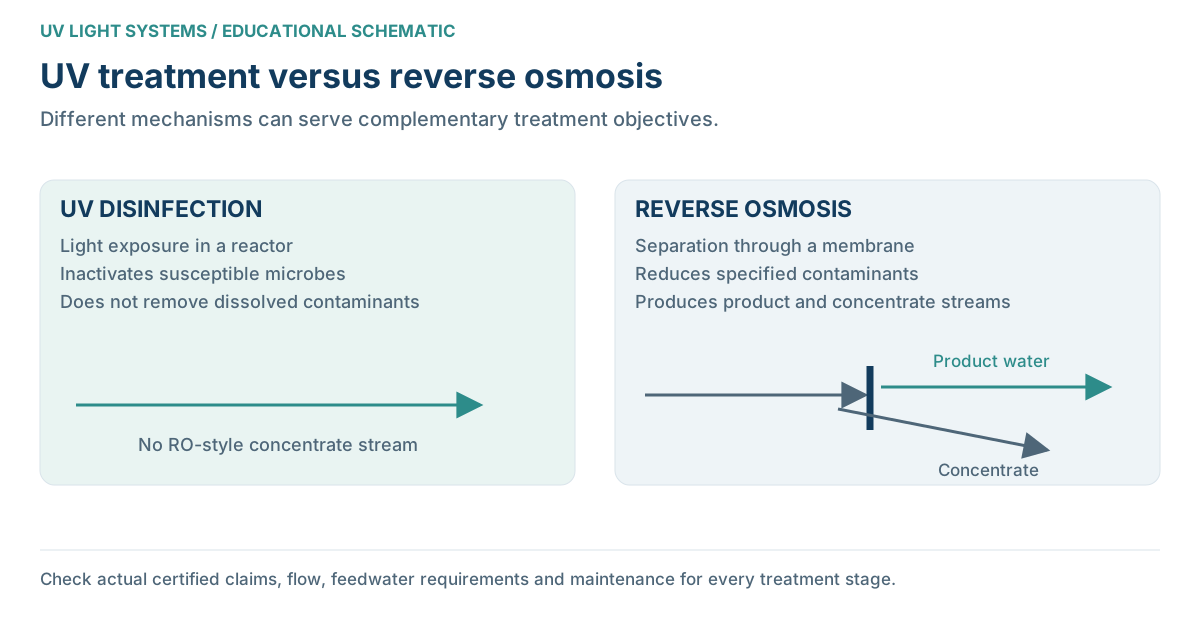
| Question | UV disinfection | Reverse osmosis |
|---|---|---|
| Microorganisms | Inactivation where the supported dose is delivered | Membrane separation can reduce microbes; verify system claims and intended source |
| Dissolved chemicals/minerals | Not removed by ordinary UV disinfection | Can reduce specified dissolved contaminants; check the exact claim |
| Sediment | Needs suitable upstream control | Generally needs prefiltration; not a substitute for source assessment |
| Flow | Rated treatment flow depends on water conditions and dose | Product flow and storage depend on pressure, temperature and system design |
| Wastewater | No concentrate stream from the UV step itself | Produces a reject/concentrate stream |
| Maintenance | Lamp, sleeve, sensor/controls and pretreatment | Prefilters, membrane, storage and other stages |
Whole-house versus one drinking tap
UV may be used at the point of entry where a microbial treatment plan calls for it. Many household RO systems are point-of-use units serving a drinking-water tap, sometimes with a storage tank. Whole-house RO also exists but involves a different design and operating scope.
A home may need microbial treatment for its supply and contaminant-specific reduction at a drinking tap. That can justify both processes, but not simply because a seller packages them together. Define the purpose of each stage.
Check certification and the contaminant list
A technology name is not a complete claim. Verify the exact certified model, rated conditions and contaminants covered. NSF/ANSI 58 concerns RO systems; NSF/ANSI 55 addresses UV microbiological treatment. The standards are not interchangeable.
A product tested to a standard is not necessarily currently certified for every claim mentioned in advertising. Consult the certifier’s listing and the manufacturer’s current performance data.
Account for water use and service
RO sends a concentrate stream to an appropriate drain or other supported arrangement. Compare documented water efficiency and actual operating assumptions, not just the product-water capacity. EPA’s WaterSense information helps distinguish water-efficiency claims from contaminant-reduction claims.
UV itself does not produce an RO-style reject stream, but its pretreatment may have separate water use or backwash needs. Compare complete-system costs, consumables and service rather than treating either device as maintenance-free.
Plan combinations deliberately
If both are needed, have the treatment train, storage and sanitation requirements designed together. Do not assume a final UV lamp solves every contamination risk or that a membrane eliminates all maintenance.
Use the filtration comparison for other media and UV ownership costs for a consistent quote. The well-water guide is the starting point when the source is a private well.
From understanding to choosing
If UV fits the goal described here, use the UV water system buying guide to compare documented specifications, installation needs and ownership costs. Keep the treatment objective and operating limits established in this guide as the basis for that comparison.
Questions People Ask Next
Does UV remove arsenic, nitrate or salts?
Ordinary UV disinfection does not remove those dissolved contaminants. Select treatment with a documented reduction claim for the substance found in testing. Do not choose UV on the basis of a broad “purification” label.
Does every RO system remove every chemical?
No. Check the specific model, certification and supported contaminant claims. Feedwater conditions and maintenance matter. A membrane technology label alone is not a guarantee for an untested source or a contaminant not covered by the system’s documentation.
Can I use UV and RO together?
Yes, when each has a defined role in a treatment plan. The configuration must consider source quality, storage, downstream sanitation and the manuals for both systems. Combining devices without resolving those details does not establish adequate treatment.
Which costs less to operate?
Compare the actual installation: electricity, consumables, water use, service and pretreatment. Whole-house UV and a small drinking-tap RO system serve different scopes, so their purchase prices alone are not a useful like-for-like comparison.
Does UV waste water?
The UV disinfection stage does not create an RO-style concentrate stream. Other stages in the same installation may use water for backwashing or regeneration, and service can require draining. Assess the complete treatment train rather than attributing all water use to one component.
Sources & further reading
Primary references for the principles discussed. Manufacturer instructions take precedence for a specific system; no independent technical reviewer is claimed.
- CDC: About Home Water Treatment Systems
- NSF: Standards for Water Treatment Systems
- EPA WaterSense: Point-of-Use Reverse Osmosis Systems
- EPA: WaterSense Specification for Point-of-Use RO Systems (PDF)
- VIQUA: UV System Maintenance (manufacturer guidance)
- VIQUA: Owner’s Manual—water chemistry and system requirements (PDF; model-specific)