Compare treatment and downstream protection
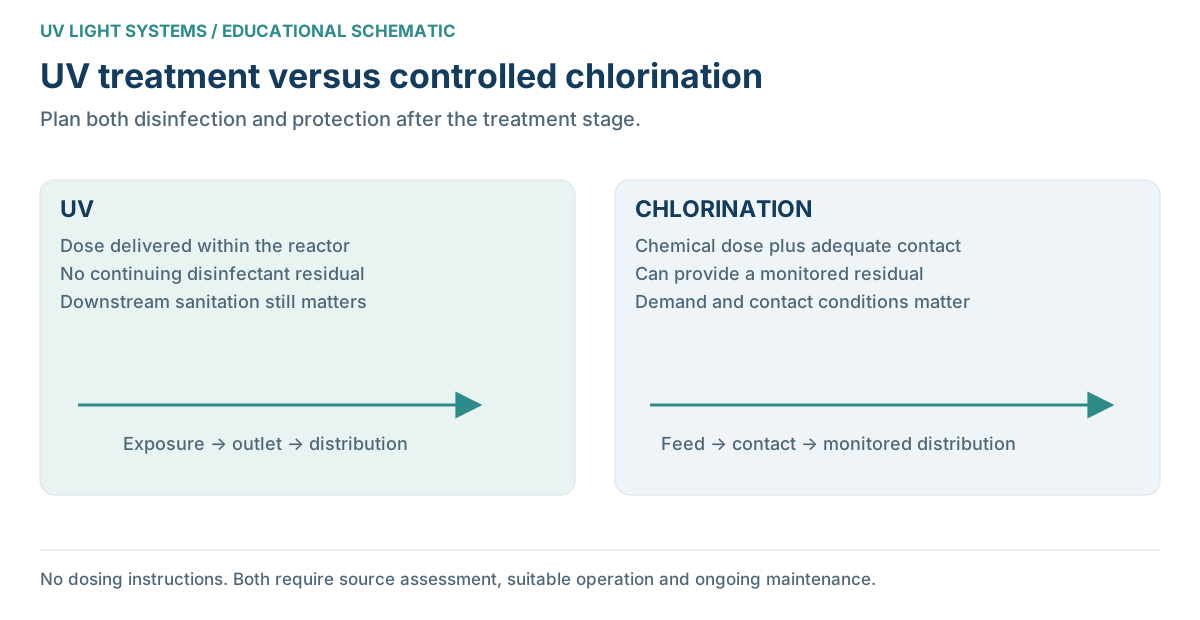
| Factor | UV | Controlled chlorination |
|---|---|---|
| Primary process | UV exposure in the chamber | Chemical dose and adequate contact |
| Residual | No continuing disinfectant residual | Can maintain residual if designed and monitored |
| Water conditions | Transmission, particles, flow and fouling matter | Demand, pH, temperature and contact conditions matter |
| Taste/odor | UV itself adds no chlorine taste | Residual may affect taste and odor |
| Maintenance | Lamp, sleeve, controls and pretreatment | Feed equipment, chemical supply, monitoring and contact/storage equipment |
| Downstream storage | Recontamination needs a separate plan | Residual can be part of distribution protection |
Contact time is different from reactor exposure
A UV design must deliver the required dose at its supported flow and water conditions. Chlorination must account for disinfectant demand and the concentration and contact time available before water is used. A container or pipe volume alone does not establish effective contact.
Different organisms respond differently to treatment. Do not transfer a claim about one bacterium or pathogen to every organism, or treat either process as absolute sterilization.
Storage tanks and distribution
A system with storage or extended downstream piping has potential contamination pathways beyond the treatment outlet. Chlorine residual can be part of a protection strategy. UV requires particular attention to downstream sanitation because its effect is confined to the exposure process.
This does not mean every private well must use continuous chlorination. Source condition, plumbing, intended use and local guidance determine the design. A one-time well disinfection procedure is also different from a continuously controlled treatment installation.
Taste, byproducts and operational responsibility
Chlorine can affect taste and odor, and reactions with material in water can form disinfection byproducts. Appropriate design and monitoring matter. UV avoids adding chlorine in its own process but still needs reliable power, pretreatment and regular service.
Removing chlorine with downstream carbon changes residual protection beyond that point. Discuss the sequence and hygiene requirements with the designer rather than adding a carbon stage solely to change taste without considering the consequences.
Choose from the water and the household’s needs
Bring source tests, storage details, flow needs and maintenance constraints to a water professional. Compare the full operating duties, not a claim that one technology is always “chemical-free” or “better.”
Read bacteria and testing and installation planning. The well-water guide explains why a recurring positive test warrants source investigation as well as treatment.
From understanding to choosing
If UV fits the goal described here, use the UV water system buying guide to compare documented specifications, installation needs and ownership costs. Keep the treatment objective and operating limits established in this guide as the basis for that comparison.
Questions People Ask Next
Is UV safer than chlorine?
There is no universal ranking independent of design and use. Both require appropriate operating conditions and maintenance. Compare the specific microbial concern, downstream protection needs and the owner’s ability to operate the proposed system, with relevant drinking-water advice.
Does chlorination replace filtration?
Not universally. Particles, dissolved contaminants and other source conditions may need separate treatment. The appropriate pretreatment and chemical process depend on testing and the equipment design. A disinfectant is not a general contaminant-removal filter.
Can UV disinfect water stored afterward?
UV treats water as it receives exposure; it does not leave a continuing residual in later storage. The tank and downstream plumbing can reintroduce organisms. A storage arrangement therefore needs its own sanitary design and monitoring plan.
Can I use household bleach without a system design?
Do not improvise continuous dosing from this comparison. Chemical concentration, contact time, source conditions and safe handling need appropriate instructions. A one-time emergency or well-disinfection procedure is different from a permanent feed system. Follow the relevant authority and equipment guidance.
Can UV and chlorine be combined?
They can have complementary roles in a professionally designed treatment process. Whether that is needed for a home depends on the source and distribution requirements. Combining technologies does not remove the need to monitor operating conditions and maintain every stage.
Sources & further reading
Primary references for the principles discussed. Manufacturer instructions take precedence for a specific system; no independent technical reviewer is claimed.
- CDC: About Water Disinfection with Chlorine and Chloramine
- EPA: Disinfection Profiling and Benchmarking—Technical Guidance (public-water-system context)
- EPA: Ultraviolet Disinfection Guidance Manual (public-water-system engineering context)
- CDC: About Home Water Treatment Systems
- VIQUA: UV System Maintenance (manufacturer guidance)
- VIQUA: Owner’s Manual—water chemistry and system requirements (PDF; model-specific)