Use a schedule tied to the actual model
| Task | Common planning trigger—not a universal interval |
|---|---|
| Lamp replacement | Many models specify about one year; confirm model and hours/calendar rule |
| Quartz sleeve cleaning | At specified service and sooner if fouling or water conditions require |
| Sensor cleaning | Manufacturer schedule or supported fault procedure, when a sensor is fitted |
| O-rings and seals | Inspect during authorized service; replace on specified schedule or condition |
| Pretreatment filters | Manufacturer interval, pressure/flow condition or specified capacity |
| Alarm and shutoff checks | Commissioning and the manual’s prescribed test/service procedure |
| Water-quality testing | Local authority/laboratory plan and after relevant incidents or work |
These are planning prompts, not a replacement for the manual. VIQUA documentation illustrates why a conventional lamp interval and a different product family’s interval should not be generalized across all UV systems.
Lamp output and sleeve transmission
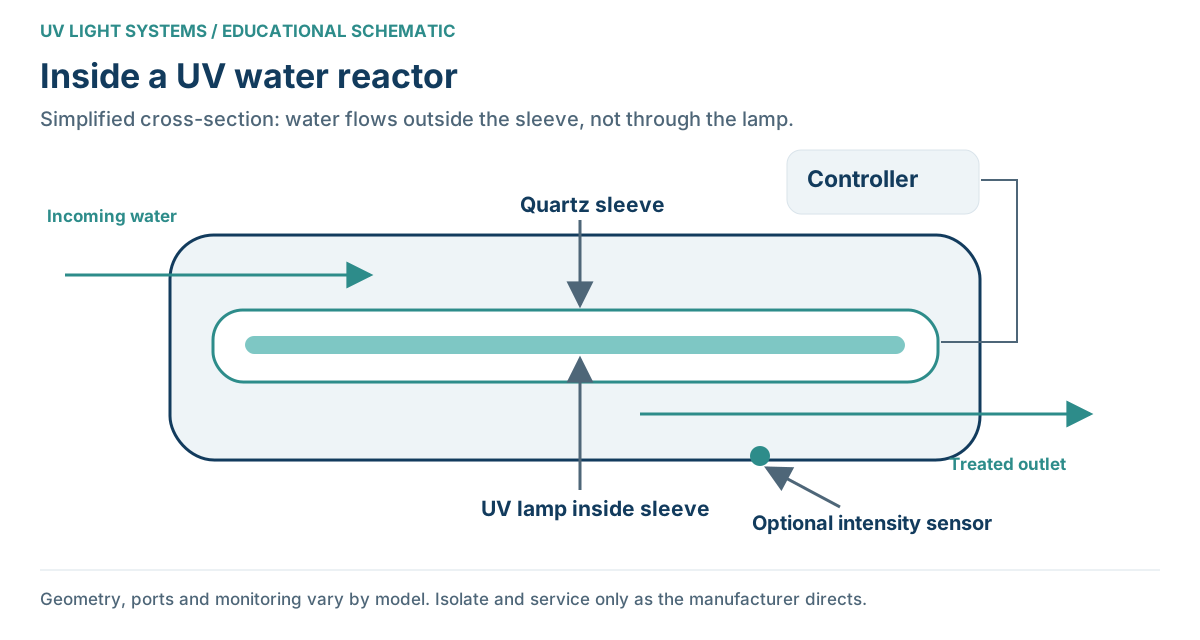
A lamp may glow after its useful germicidal service interval. Use the specified replacement part and controller compatibility. Keep the installation date and next due date so the decision does not depend on appearance.
Mineral deposits can reduce transmission through the quartz sleeve. Clean only using the approved method, and inspect for damage when the manual calls for it. Do not substitute a generic household cleaning recipe for instructions covering the actual sleeve and seals.
Sensors, seals and protective controls
An intensity sensor, where fitted, has a defined measurement and alarm role; it is not a universal detector for all water contaminants. Follow its cleaning and diagnostic instructions. Never defeat an alarm or shutoff to avoid an unresolved fault.
Seals must be compatible and installed as specified. Opening a pressurized chamber, handling a hot lamp or restoring electrical equipment requires the manual’s isolation and service procedures. Arrange qualified service when the task exceeds owner maintenance.
Keep pretreatment and testing in the plan
A UV maintenance visit does not replace sediment-filter service, conditioning-system care or source testing. Changes in water quality can matter even when the lamp is new. Keep laboratory results and the equipment’s operating limits together.
For private wells, follow local testing guidance and seek advice after contamination, flooding, repairs or other relevant changes. A passing sample is not proof that every future operating condition will remain acceptable.
Record the fault and corrective action
Use the replacement-parts guide and the blank maintenance log. Record the part, date, work performed and next due task. A note saying only “alarm reset” does not explain what was corrected.
After service or an interruption, follow the documented restart and downstream sanitation requirements. The installation handover should identify the alternative-water plan while treatment is uncertain.
Choosing a UV System: What Actually Matters
After resolving this page’s technical question, compare the following requirements for your installation. The water system buying guide brings the full specification record together.
| Criterion | What to verify |
|---|---|
| Lamps, sleeves and seals | Verify part numbers, lamp-life rating, service intervals, replacement prices and parts availability. |
| UV intensity sensor and alarms | Distinguish intensity monitoring, lamp-failure detection, reminders and an actual automatic shutoff. |
| Typical ownership cost | Include testing, pretreatment, lamps, filter consumables, electricity, service and occasional parts. |
Questions People Ask Next
Must every UV water lamp be replaced annually?
No. Annual replacement is common for some conventional products, but schedules differ by lamp and system. Use the exact model’s instructions, including whether the interval is based on time or operating hours. A different product family’s longer interval is not permission to extend yours.
Can I just reset the lamp timer?
Reset it only as instructed after the required task has been completed. A timer reset does not restore output to an aged lamp. If the indication reports a different fault, identify and correct that cause rather than treating every alarm as a replacement reminder.
How often should I clean the sleeve?
Use the manual and actual fouling conditions. Water chemistry can make cleaning necessary more frequently than a basic calendar schedule. If fouling is recurring, reassess pretreatment rather than indefinitely compensating with more cleaning or a higher-capacity lamp.
Does a UV sensor test my drinking water?
No. A sensor measures a specified operating parameter such as UV intensity; it does not test for every microorganism or chemical. Laboratory testing and source assessment provide different information and remain important where appropriate.
What should happen after service?
Complete the equipment’s restart and operational checks, verify seals and controls using the prescribed method, and follow any downstream sanitation or testing requirements. Do not assume a new lamp alone establishes adequate treatment throughout the plumbing.
Sources & further reading
Primary references for the principles discussed. Manufacturer instructions take precedence for a specific system; no independent technical reviewer is claimed.