From source to treatment chamber
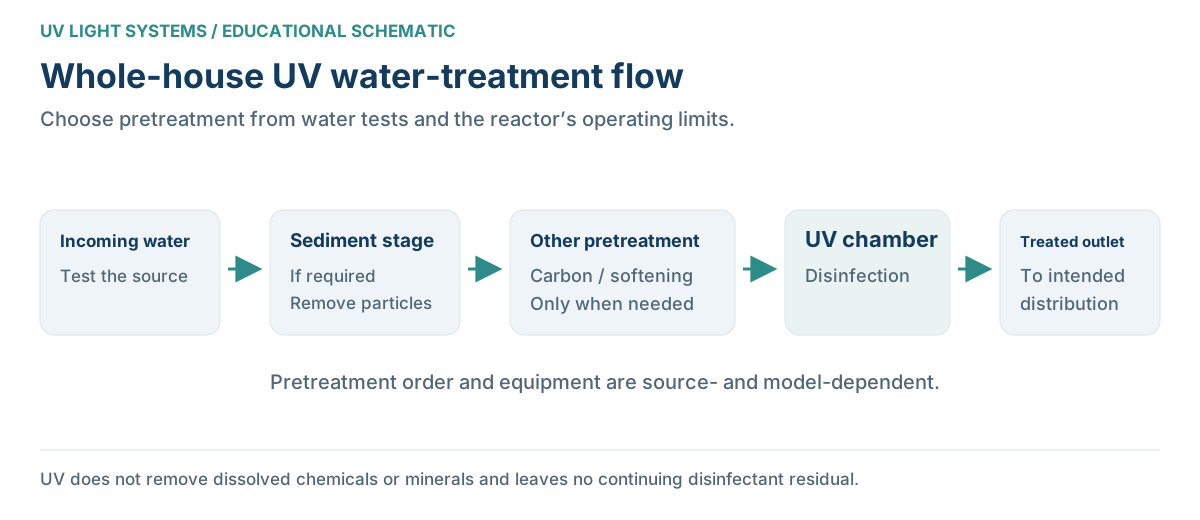
Water quality is assessed before equipment is selected. Necessary sediment removal and other conditioning occur ahead of the UV reactor. The treated outlet then serves the intended plumbing, with startup and downstream sanitation handled under the installation plan.
The sequence is not a universal prescription: actual stage selection and order depend on the contaminants, plumbing and equipment manuals. An optional carbon filter is not a complete treatment for all chemicals.
Lamp, sleeve and reactor
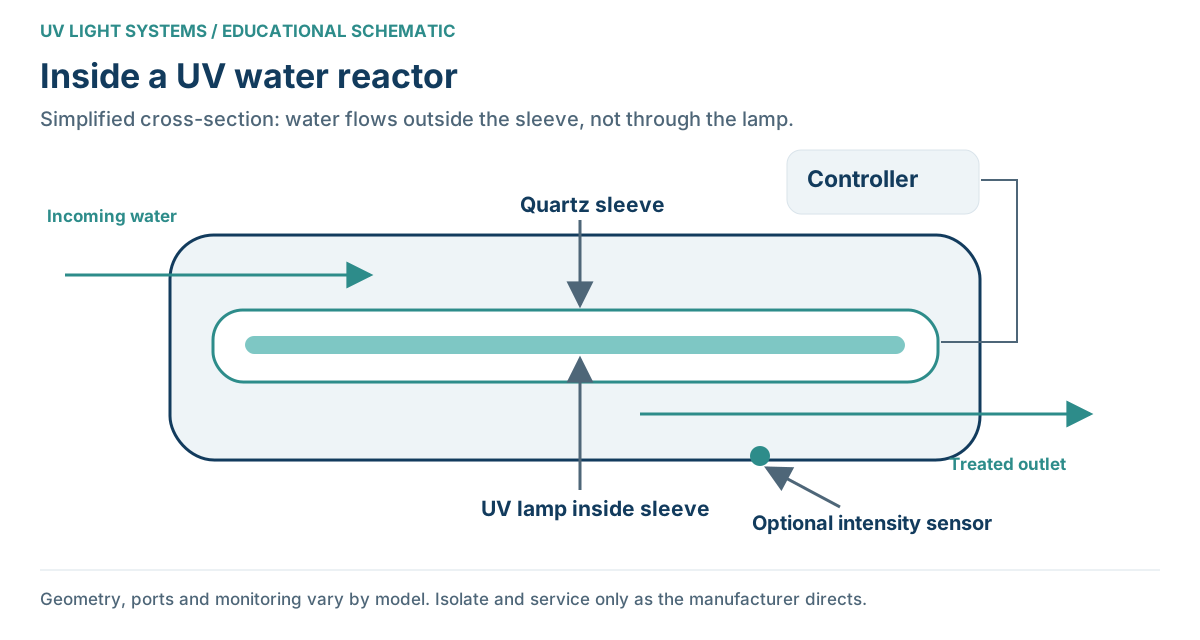
A lamp emits UV into the chamber, commonly through a protective quartz sleeve. Water flows outside the sleeve; the lamp is not simply submerged in the water. A controller powers the lamp and provides the model’s supported indicators or alarms.
Some systems include an intensity sensor and protective controls. These features differ by model. Understand what is measured, what raises a fault and whether the installation stops water flow or only alerts the owner.
Flow, dose and exposure
Conventional low-pressure mercury UV lamps commonly emit near 254 nm. Wavelength is only one part of treatment performance. The reactor must deliver the needed exposure to the water passing through it; increasing flow can shorten residence time.
A label stating electrical lamp watts cannot establish delivered dose. In a real reactor, the radiation field and water paths are uneven, so a simple intensity-times-time calculation is not a substitute for validated or certified performance at specified conditions.
Use UV water sizing to organize flow and water-quality information before choosing equipment.
Clear-looking water is not the whole test
Particles can shield organisms, while substances that absorb UV can reduce transmission. Turbidity and UV transmittance describe different properties, and neither can be reliably judged by looking at a glass. Iron, manganese and hardness can also matter to pretreatment and fouling.
Compare test results with the exact reactor’s limits. Do not use another model’s numbers as universal specifications. UV does not remove the underlying minerals, sediment or dissolved chemicals.
What happens after the reactor
UV does not leave a continuing disinfectant residual. A contaminated downstream tank or plumbing section can reintroduce organisms, so commissioning, source protection and restart procedures remain important. See microbial treatment and testing for that distinction.
Follow the lamp, sleeve and sensor maintenance plan and know how to respond to an outage. The installation guide covers access, protection and handover questions.
Choosing a UV System: What Actually Matters
After resolving this page’s technical question, compare the following requirements for your installation. The water system buying guide brings the full specification record together.
| Criterion | What to verify |
|---|---|
| Application and tested water | Define point-of-entry or point-of-use treatment, the microbial objective and the required pretreatment. |
| Flow, UV dose and water quality | Compare rated flow at the documented dose, UV transmittance and lamp-life condition. Include peak simultaneous demand. |
| UV intensity sensor and alarms | Distinguish intensity monitoring, lamp-failure detection, reminders and an actual automatic shutoff. |
Questions People Ask Next
Does the lamp touch the water?
In common residential reactor designs, a quartz sleeve separates the lamp from the flowing water and transmits UV. Use the actual equipment manual for its arrangement. Sleeve cleanliness, seals and safe service procedures are separate from the lamp’s electrical operation.
Does more lamp power mean more treatment?
Not by itself. The dose delivered depends on the reactor, water transmission, lamp output and flow. Compare the complete system’s supported treatment conditions rather than electrical watts alone. A larger number on a lamp label is not a universal sizing method.
Does UV remove dissolved minerals?
No. UV disinfection is not softening or mineral removal. If hardness or other constituents exceed the equipment’s requirements, a separate treatment stage may be needed. Select that stage from testing and documented treatment claims.
Is the water sterile afterward?
Do not assume absolute sterilization. Performance is specific to organisms, dose and operating conditions, and contamination can occur downstream. Use appropriate testing and a supported system design instead of treating a powered lamp as a guarantee of water quality.
Why is a filter often installed first?
Suspended material can interfere with exposure, and pretreatment may be required to meet the reactor’s limits. Filter type and any additional conditioning depend on the source. A filter shown in a diagram is not proof that the same cartridge suits every well.
Sources & further reading
Primary references for the principles discussed. Manufacturer instructions take precedence for a specific system; no independent technical reviewer is claimed.