Protect eyes and skin
FDA describes the risk of injury from UVC exposure. An installed lamp should be used only in its intended configuration. Do not energize an unshielded lamp to demonstrate brightness, inspect a surface or attempt occupied-room mold treatment.
Service access changes the exposure situation. Follow the manual’s isolation procedure, even where an interlock is provided. Do not bypass protective controls or assume ordinary eyewear makes an improvised procedure safe.
UVA, UVB and UVC are not interchangeable
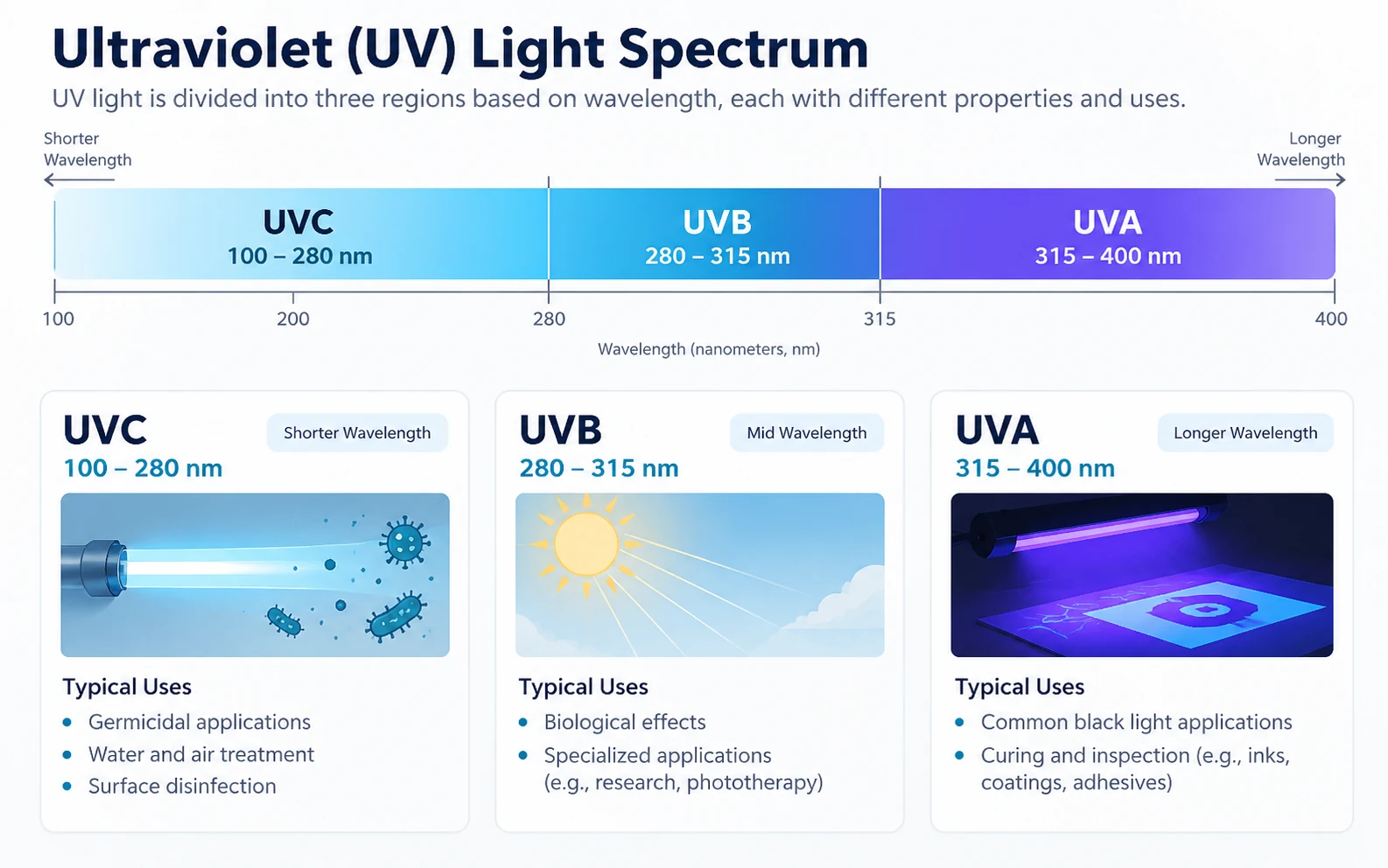
Use the specified lamp for the system. A visible purple or blue glow does not establish wavelength, useful output or safe exposure. A product intended for another application should not be repurposed as a germicidal treatment device.
Ask about ozone and complete-device emissions
Some UV sources and other air-cleaning processes can produce ozone. Ask for documentation for the complete product, including additional technologies, rather than assuming all UV-labelled equipment has the same emissions characteristics.
Ozone should not be used as a substitute for appropriate indoor-air-quality measures in occupied spaces. A smell is neither a reliable safety measurement nor proof of effective treatment. See the EPA air-cleaner guidance in the references below.
Account for electrical, material and lamp hazards
Installation must address the electrical supply, surrounding materials and secure mounting. Follow the manufacturers’ requirements for compatibility and service. Lamp disposal also depends on the lamp type; consult its documentation and local requirements, especially for mercury-containing lamps.
Keep manuals and model details accessible. If you do not know which lamp or controller is installed, identify the equipment before attempting a replacement. Do not use generic wiring or disassembly instructions in place of the actual manual.
For water, plan the failure response
A water-treatment fault needs more than a lamp replacement reminder. Understand alarm behavior, any automatic shutoff and the approved restart procedure. Follow relevant drinking-water advice and maintain an alternative-water plan while treatment is uncertain.
UV does not remove chemical contaminants. Emergency measures must be appropriate to the actual problem; boiling is not a universal response to chemical contamination. Use the linked public-health guidance and advice from the local authority.
Questions People Ask Next
Can I look at a UV lamp briefly?
Do not look directly at an energized germicidal lamp. Follow the system’s inspection method and use indicators only as described in the manual. A brief view should not be treated as safe by assumption. If you suspect an exposure injury, stop using the device and obtain appropriate medical advice.
Does blue light mean the lamp is safe?
No. Visible appearance does not establish the radiation reaching the eyes or skin, the wavelength emitted or the treatment dose. A lamp’s enclosure and prescribed use are central to protection. Do not judge safety from the brightness, color or apparent similarity to an ordinary household light.
Are all UV systems ozone-free?
No universal claim should be made across all products. Ask for documentation for the exact device, especially when other treatment processes are included. The absence of a noticeable smell is not proof of low emissions. Compare manufacturer-supported information and relevant independent testing for the complete system.
Can I defeat the door switch to check the lamp?
Do not bypass protective controls. Use the manufacturer’s diagnostic procedure and arrange qualified service when necessary. A door switch or interlock exists to support safe operation, and defeating it changes the exposure conditions. A visible glow is not an adequate performance test in any case.
What if a drinking-water UV system loses power?
Follow the documented alternative-water and restart plan. Whether the system stops water flow depends on its installed controls. Do not assume water remains adequately treated because it looks normal, and do not rely on a generic fix for every contaminant. Relevant authority guidance and the equipment manual should determine the response.
Sources & further reading
Primary references for the principles discussed. Manufacturer instructions take precedence for a specific system; no independent technical reviewer is claimed.