What UV-C does
UV-C is the short-wavelength ultraviolet band commonly associated with germicidal treatment. Conventional low-pressure mercury lamps typically emit near 254 nanometers; other sources have different outputs. A decorative UVA black light is not a substitute for the specified germicidal lamp.
Microbial inactivation means reducing an organism’s ability to reproduce or infect under the tested conditions. It does not mean the organism or its fragments have been collected. Different organisms require different exposures, so a result for one target cannot be applied to every contaminant.
Why lamps are often near the evaporator coil
During cooling, moisture can condense on the indoor coil. Persistently damp surfaces can support biological buildup when other conditions permit. A stationary surface is a practical target because it can receive repeated or continuous irradiation in a fixed enclosure.
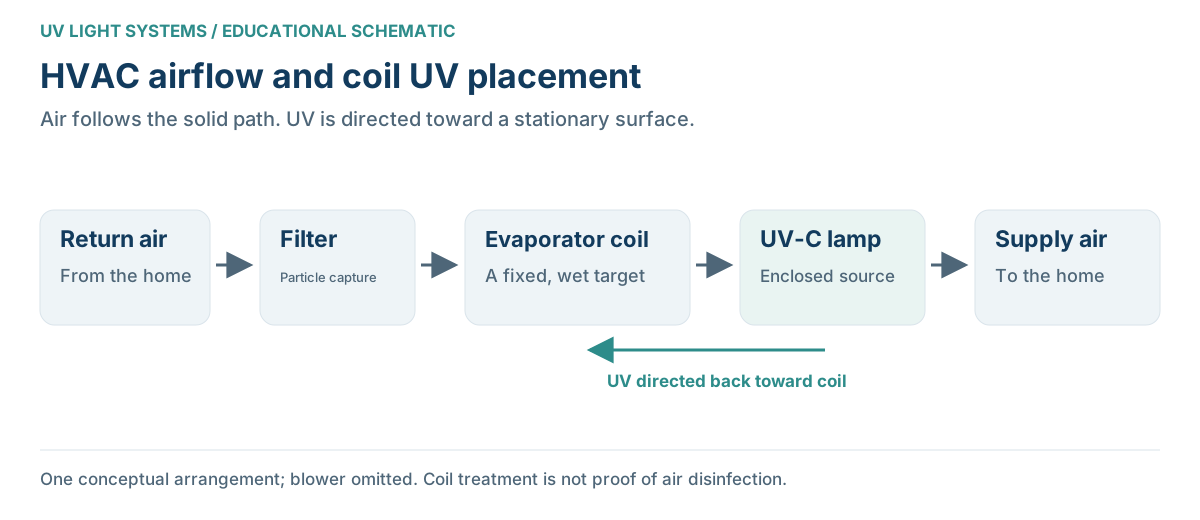
The schematic shows one conceptual coil-treatment arrangement. Its lamp is downstream of the coil and directed back toward the surface; the order of the boxes does not mean air is always disinfected after passing the coil. Equipment layouts vary.
See UV treatment of evaporator coils and air-handler compatibility for the surface and cabinet details.
Dose depends on the installation
| Factor | Why it changes the result |
|---|---|
| Exposure time | A fixed surface can accumulate exposure; fast-moving air has a shorter treatment window |
| Intensity and distance | The radiation reaching the target matters, not just lamp input watts |
| Airflow | Velocity and flow patterns affect residence time in an airstream installation |
| Placement | Coil fins, equipment and dirt can create shadows |
| Operating conditions | Temperature, deposits and lamp aging can affect useful output |
Intensity multiplied by time is a useful introductory description of dose for constant exposure. Actual systems have uneven fields and changing conditions, so this simple relationship is not a DIY sizing formula.
What the lamp does not replace
Keep appropriate filtration for dust and other particles. Correct drainage, clean deposits and address the moisture source rather than treating UV as complete HVAC mold remediation. A lamp aimed at one surface does not treat hidden building materials.
For the evidence behind particular outcomes, read whether HVAC UV lights actually work. Whole-home air quality and health outcomes cannot be inferred from a lamp-on indicator.
Ozone, servicing and ownership
Request ozone information for the complete device, especially if it adds ionization or photocatalytic processes. Use the UV safety guide to understand exposure precautions. Germicidal lamps belong in their supported enclosed configuration.
Follow the exact lamp replacement schedule even if it still glows. Compare installation requirements and ongoing HVAC UV costs before buying; electrical wattage and operating hours are inputs to an energy estimate, not an effectiveness rating.
Choosing a UV System: What Actually Matters
After resolving this page’s technical question, compare the following requirements for your installation. The HVAC buying guide brings the full specification record together.
| Criterion | What to verify |
|---|---|
| Application and location | Identify coil irradiation, moving-air treatment or a documented combined design. Mark the actual target and mounting location. |
| Coverage and performance evidence | Compare coil dimensions and cabinet geometry; for moving air, require evidence at the intended airflow and exposure conditions. |
| Warranty, certification and documentation | Read exclusions and exact model listings. Electrical safety certification alone does not establish microbial treatment performance. |
Questions People Ask Next
Does UV kill everything passing through the air handler?
No. Passing a lamp does not establish an adequate dose for every organism. Air velocity, exposure geometry and output must match a supported design. A coil lamp can have a useful surface-control role without providing validated air disinfection.
Should a coil UV lamp run continuously?
Many surface-treatment products are designed for continuous operation, but follow the specific controller and lamp instructions. Do not connect a continuously powered product to a blower relay by assumption. Changing the operating schedule changes exposure and can conflict with the intended design.
Does visible blue light perform the treatment?
Visible glow is not a measure of useful UV-C output. Use the product’s specifications, prescribed service interval and any supported monitoring. Never look at an energized lamp to judge whether it is sufficiently bright.
Why does distance from the coil matter?
The radiation reaching a surface depends on the source and geometry. A lamp farther away, behind a component or aimed at only one face may deliver a different dose. Follow supported clearances and coverage requirements rather than a universal distance rule.
Can UV replace the HVAC filter?
No. The filter captures particles; UV acts through exposure. The installed filter still needs suitable efficiency, fit, airflow and replacement. Adding UV does not turn a damaged or missing filter into an acceptable system.
Sources & further reading
Primary references for the principles discussed. Manufacturer instructions take precedence for a specific system; no independent technical reviewer is claimed.