Map the cabinet before selecting a lamp
Identify the filter, blower, coil and condensate collection area. Their order and orientation differ by equipment. In tight cabinets, a mounting location may place the lamp too close to a material that is not intended for UV exposure, or leave the target in shadow.
A technician should compare the proposed configuration with the UV and air-handler manufacturers’ documentation. The illustration below explains common treatment ideas; it is not a cutting template or a model-specific layout.
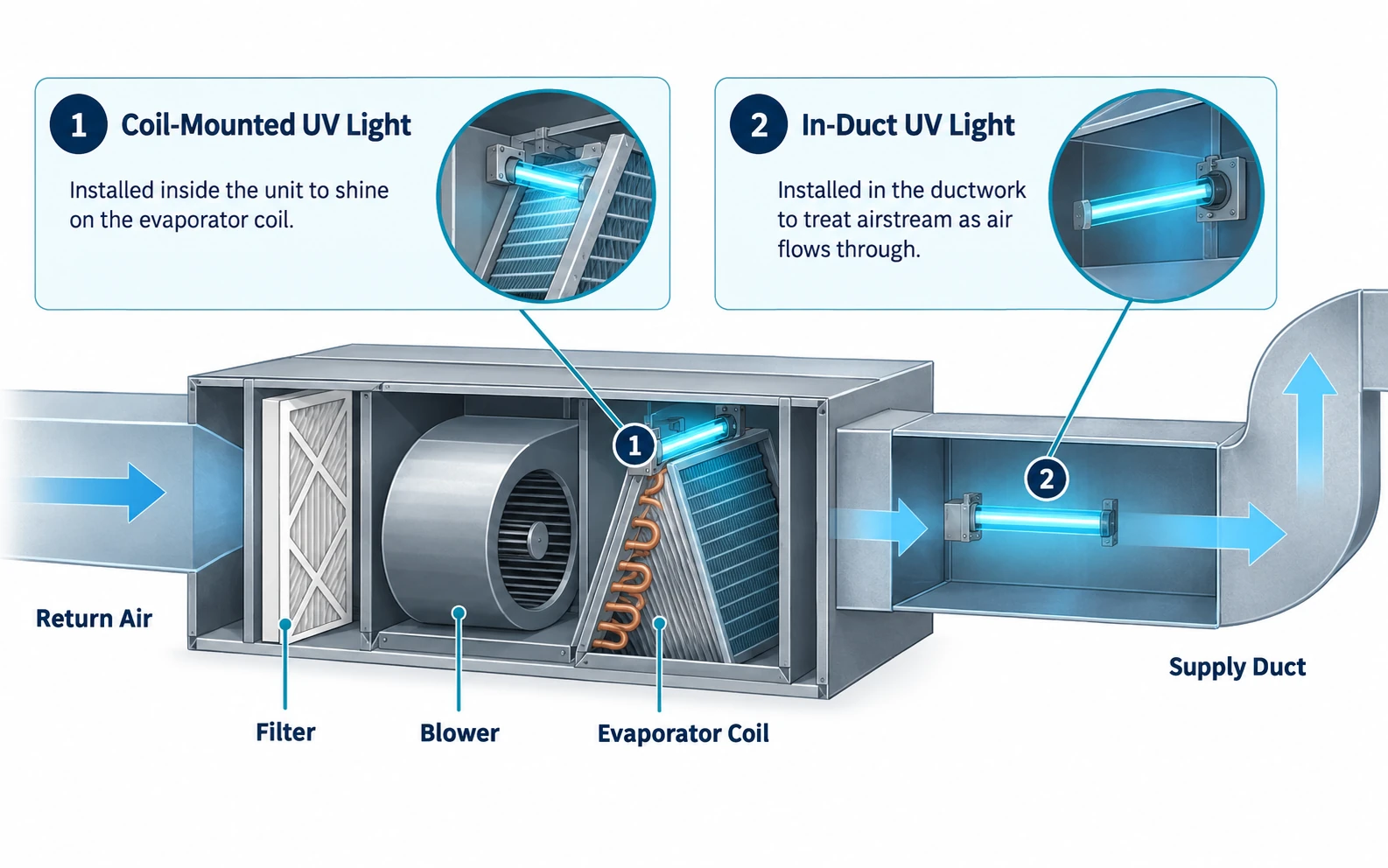
Make access part of the design
Check the direction in which the lamp is removed and the space available outside the cabinet. A wall, pipe or adjacent appliance can turn routine replacement into a larger service job. Access panels must remain usable after installation.
Ask how the enclosure protects service personnel when opened. Follow the documented isolation and interlock procedure; an indicator or switch should never be treated as a substitute for the prescribed electrical safety process.
Separate UV treatment from moisture repairs
A persistently wet cabinet or recurring contamination deserves inspection of drainage, airflow and insulation conditions. UV cannot correct a drain defect. Cleaning and repair may be necessary before a lamp is considered for ongoing surface control.
If the target is moving air, require performance information appropriate to the actual airflow and operating conditions. A lamp selected for a small surface is not automatically a validated airstream treatment system.
| Check | Ask the installer |
|---|---|
| Coverage | Which surfaces receive UV and which remain shadowed? |
| Materials | Are wiring, insulation and plastics compatible or shielded? |
| Service | Can the lamp and controller be accessed safely? |
| Documentation | Which instructions and part numbers will be left with the owner? |
Keep a usable service record
Record the air-handler model, UV model, lamp part number, installation date and prescribed service interval. Include the location of the isolator and the commissioning documentation. The replacement-lamp guide explains why visible glow is not enough to establish continued output.
For planning, use the cost worksheet to compare the complete installation. An accessible, documented system can be easier to maintain than an apparently cheaper installation with difficult lamp removal.
Choose a surface or airstream objective
Compare coil irradiation with airstream UV treatment before accepting a claim about the whole cabinet. Use the placement examples to discuss line of sight and the coil-treatment guide to identify the actual target.
Choosing a UV System: What Actually Matters
After resolving this page’s technical question, compare the following requirements for your installation. The HVAC buying guide brings the full specification record together.
| Criterion | What to verify |
|---|---|
| Application and location | Identify coil irradiation, moving-air treatment or a documented combined design. Mark the actual target and mounting location. |
| Coverage and performance evidence | Compare coil dimensions and cabinet geometry; for moving air, require evidence at the intended airflow and exposure conditions. |
| Wattage and electrical supply | Check complete-system input, required voltage, ballast/controller and the proposed power source with the installer. |
| Replacement lamps and service | Obtain the exact lamp part number, rated replacement interval, current price, availability and removal clearance. |
Questions People Ask Next
Can the lamp be mounted directly over the drain pan?
Only if the proposed mounting is supported by the equipment design and material compatibility. The pan itself, nearby insulation and wiring must be considered. The goal may be surface treatment, but a diagram cannot establish the necessary clearances or shielding. Ask for a model-specific explanation and written manufacturer guidance.
Is one lamp enough for an air handler?
Lamp count alone cannot answer the coverage question. Coil shape, shadows, output and distance all influence treatment. Ask the supplier to explain the intended coverage with the proposed configuration. Do not assume that adding more lamps automatically improves safety or makes an installation suitable for treating moving air.
Can UV damage parts inside the cabinet?
Material compatibility needs evaluation. Some components may require shielding or may not be suitable for prolonged exposure in the proposed location. Use the equipment manufacturers’ instructions and ask how vulnerable components will be protected. A lamp’s physical fit does not establish that the surrounding materials are appropriate.
What if I still see growth after installation?
Have the condition assessed. Possible issues include unaddressed moisture, deposits that require cleaning, shadowed surfaces or a system that is not operating as intended. Do not look directly at an energized lamp to investigate. Compare the installation and maintenance records with the product requirements, and address the source of recurring moisture.
Can the UV system share a service visit with the air handler?
Yes, if the technician is qualified for the work and the timing follows each manufacturer’s requirements. Ask the invoice to identify the UV tasks separately: lamp condition, replacement if due, cleaning where applicable and checks of controls and enclosure. General HVAC maintenance does not automatically include all UV-specific service.
Sources & further reading
Primary references for the principles discussed. Manufacturer instructions take precedence for a specific system; no independent technical reviewer is claimed.