Define the affected area first
Distinguish growth on an exposed coil from contamination elsewhere in a duct system or building. A lamp installed beside one coil cannot treat a wall cavity or every length of ductwork. Claims about “whole-home mold elimination” should not be accepted as an installation objective.
EPA cautions that typical residential UVGI units have limitations, especially for more resistant organisms and spores. Inactivation also does not mean physical removal. Use a realistic, local surface-treatment goal rather than assuming the entire indoor environment has been remediated.
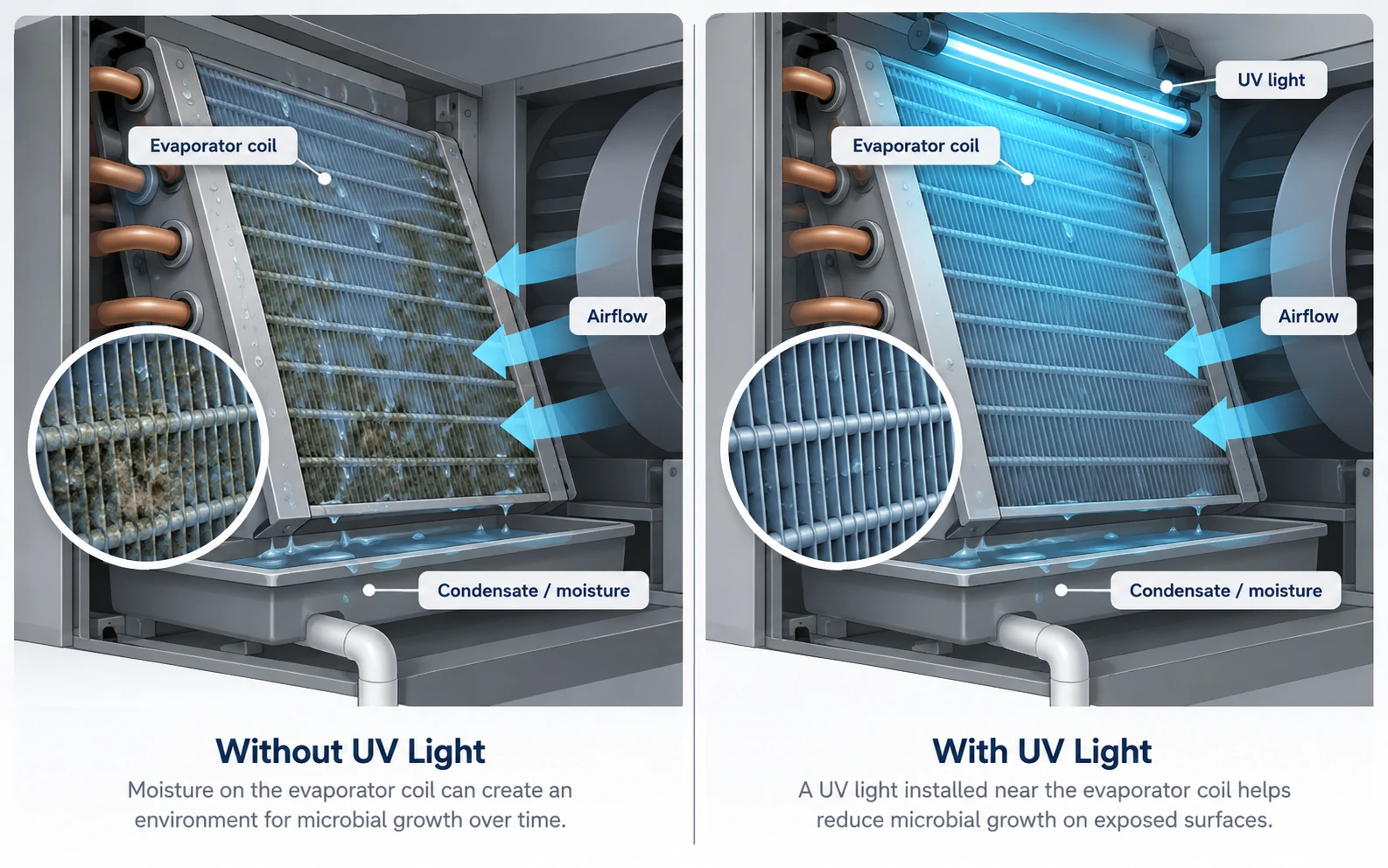
Moisture control comes before the accessory
Ask for an inspection of condensate handling and the causes of recurring wetness. Existing deposits can need cleaning before a UV system is considered. Document any work needed independently of the lamp so that the same problem is not repeatedly treated as a failed accessory.
For significant or recurring building contamination, seek appropriate assessment and remediation advice. A visible change in a single HVAC surface is not evidence that hidden contamination or occupant concerns have been resolved.
Understand coverage and exposure
| Condition | Why it matters |
|---|---|
| Direct line of sight | Objects and coil geometry can prevent UV reaching a surface |
| Distance and output | The energy reaching the target differs from electrical lamp wattage |
| Exposure duration | Surface treatment and rapidly moving air have different exposure conditions |
| Deposits and cleanliness | Material on a surface can interfere with treatment and still require removal |
| Lamp condition | A glowing lamp does not prove that its rated useful output remains |
This is why selecting a lamp by cabinet size or marketing claims is insufficient. Have the installer explain the coverage and the maintenance plan for the exact equipment.
Judge the proposal by the problem it solves
A useful scope separates moisture repair, cleaning and any proposed UV accessory. Ask what can be observed and documented after the work, rather than requesting an unsupported percentage of “mold killed.” See installation planning for the handover details.
For mold beyond the equipment, read Does UV Light Kill Mold? before choosing a treatment. If the concern is airborne particles, review UV and filtration rather than expecting the lamp to collect them.
Assess the claim and the coverage separately
Read the evidence for HVAC UV outcomes alongside coil surface treatment. A proposal needs relevant evidence and supported lamp placement; neither a promising test nor a convenient mounting point alone establishes an effective installation.
From understanding to choosing
If UV fits the goal described here, use the HVAC UV light buying guide to compare documented specifications, installation needs and ownership costs. Keep the treatment objective and operating limits established in this guide as the basis for that comparison.
Questions People Ask Next
Does UV remove mold from a coil?
UV does not physically remove material from a coil. A suitable system may help control susceptible growth on exposed surfaces, but cleaning can still be needed for deposits already present. Evaluate the coil condition and moisture source before installation, then maintain both the HVAC equipment and UV accessory according to their instructions.
Can dead mold still be a concern?
Yes. Inactivation is not the same as removal, and mold material can remain relevant to allergic reactions. That is one reason UV should not be sold as a complete remediation method or a guaranteed symptom treatment. Cleaning, moisture correction and appropriate assessment remain separate parts of addressing contamination.
Will a lamp reach both sides of the coil?
Not necessarily. Coil shape, fins, mounting hardware and other obstructions can create shadows. A mounting diagram should identify what is actually irradiated. Do not assume that a bright visible glow represents uniform germicidal exposure across the whole assembly. Ask for coverage information appropriate to the specific configuration.
Should I buy UV before arranging cleaning?
Start with an assessment of the current condition. Cleaning or repairs may be necessary regardless of whether UV is later added. Ask the contractor to explain the sequence and itemize each task. The purpose of an accessory for ongoing surface control should be distinct from the work needed to address existing contamination.
Does UV prevent mold throughout a house?
No. A localized HVAC installation cannot correct roof leaks, damp building materials or hidden wall contamination. It only acts where sufficient radiation reaches the target. Treat claims of whole-house mold prevention cautiously and direct the first investigation toward moisture sources and affected materials, not the presence or absence of a lamp.
Sources & further reading
Primary references for the principles discussed. Manufacturer instructions take precedence for a specific system; no independent technical reviewer is claimed.