Why cooling coils stay damp
When coil surfaces are below the air’s dew point, moisture condenses and should drain away through the condensate system. Operation in humid conditions can mean long periods of wetting. Wetness alone does not prove a mold problem, but it helps explain why the coil and pan deserve inspection.
Biological buildup can develop when conditions support growth. Dirt and other deposits can also accumulate, so have the material and system condition assessed rather than assuming all fouling is living growth.
Stationary surfaces have an exposure advantage
A coil stays in the same treatment zone, allowing exposure to accumulate over time. A moving air parcel may cross a lamp zone quickly. These different residence times explain why a surface-treatment design is not automatically an air-disinfection design.
Read coil UV versus airstream UV before applying air-disinfection claims to a coil accessory.
Placement, line of sight and the drain pan
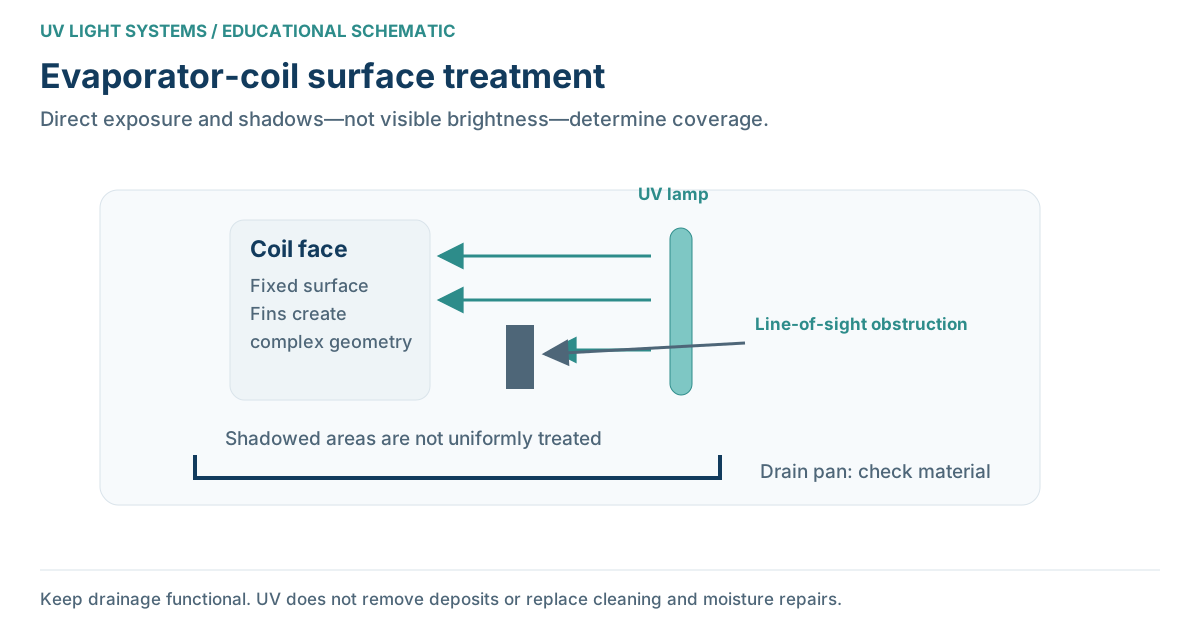
Lamp orientation should cover the intended coil face within the manufacturer’s distance and temperature limits. Complex coil geometries may need another arrangement. Mounting on the supply side is one option, not a universal rule.
A pan or another surface can be a treatment target only if the design permits it and the material tolerates the exposure. Pan treatment does not clear a blocked drain or correct standing water. Map which surfaces remain shadowed and preserve normal service access.
Protect surrounding materials
Some plastics, insulation, filter media and wiring materials can be damaged by UV exposure. Compatible materials, supported shields and manufacturer-approved positioning matter. Do not improvise reflective barriers or direct radiation at components without checking the instructions.
The enclosure must protect occupants and technicians. Use professional installation where mounting, electrical work or exposure assessment is required; a photograph cannot establish a safe clearance for a different cabinet.
Compare the air-handler checks with the placement examples.
Maintain the target and the lamp
Clean or repair the equipment as required before relying on ongoing irradiation. Record the lamp part number, service interval and removal clearance. A lamp that still emits visible light may be due for replacement.
Recurring growth warrants a review of moisture, coverage and operation. Use the HVAC mold guide and installation checklist to keep those issues separate.
Choosing a UV System: What Actually Matters
After resolving this page’s technical question, compare the following requirements for your installation. The HVAC buying guide brings the full specification record together.
| Criterion | What to verify |
|---|---|
| Coverage and performance evidence | Compare coil dimensions and cabinet geometry; for moving air, require evidence at the intended airflow and exposure conditions. |
| UV-C lamp type and quantity | Record the specified lamp technology, length and count. More lamps or higher electrical watts do not establish the dose reaching a target. |
| Materials and ozone characteristics | Review shielding, component compatibility and model-specific ozone/emissions documentation. |
| Replacement lamps and service | Obtain the exact lamp part number, rated replacement interval, current price, availability and removal clearance. |
Take coil measurements into the purchase decision
Use the HVAC sizing checklist to document geometry and the proposed lamp layout before selecting equipment. This keeps the purchase tied to the surfaces actually being treated.
Questions People Ask Next
Should the lamp point directly at the coil?
It should be oriented to deliver the intended exposure in a supported configuration. Exact alignment and spacing depend on the lamp and coil geometry. Direct line of sight helps explain coverage but does not override electrical, material or service-clearance requirements.
Can UV reach the back of every fin?
No. Fins and other components can create shadowed areas. A lamp shining on one face does not establish uniform exposure throughout the heat exchanger. Ask the installer to explain which surfaces the design targets and which it cannot reach.
Will UV stop the coil from getting wet?
No. Condensation is part of normal cooling and dehumidification when conditions allow it. UV does not change the need for proper condensate collection and drainage. Investigate excessive or persistent wetness as an equipment issue.
Can the drain pan be damaged?
Material compatibility is product-specific. Some materials may require protection or may be unsuitable for the proposed exposure. Check both the HVAC and UV documentation instead of assuming that every pan or liner can tolerate a nearby lamp.
Does a coil lamp need to run when the blower is off?
Many surface systems specify continuous operation, but follow the exact manufacturer’s control instructions. Do not assume an air-treatment switching strategy applies to a surface-treatment product. The operating schedule is part of the exposure design.
Sources & further reading
Primary references for the principles discussed. Manufacturer instructions take precedence for a specific system; no independent technical reviewer is claimed.