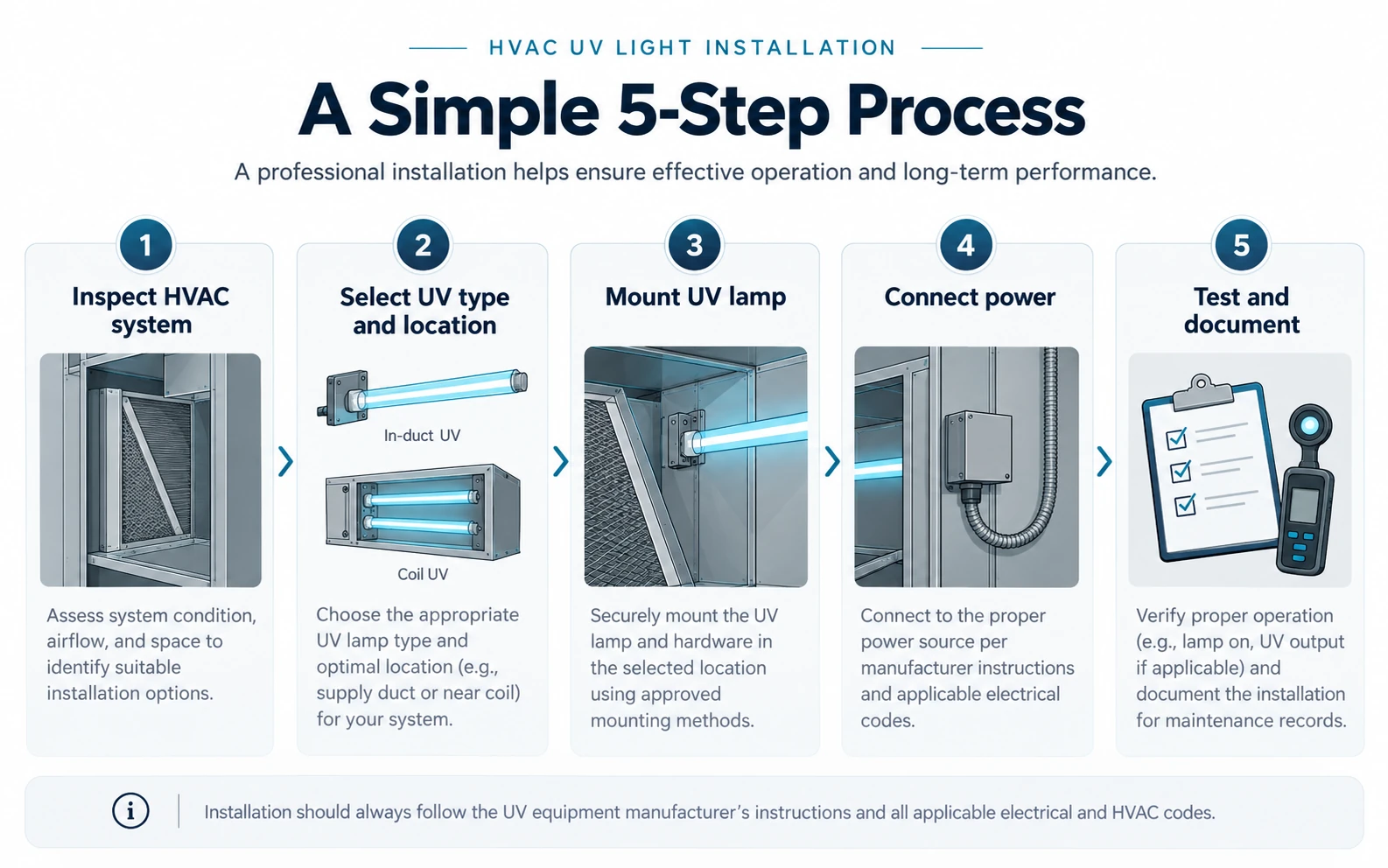
1. Assess the equipment and the objective
Identify whether the goal is coil-surface control or airstream treatment. Document the HVAC model and inspect the intended target. Discuss existing contamination, drainage and cleaning needs separately; a lamp is not a repair for those conditions.
For airstream treatment, ask what operating conditions support the product’s claims and whether they match the proposed location. The amount of free space available is not sufficient evidence of treatment effectiveness.
2. Choose a supported location
The installer should confirm coverage, distance, temperature suitability and shielding of vulnerable materials. Also check lamp-removal clearance and access to the original equipment’s service panels. A crowded installation can make routine replacement unnecessarily difficult.
Agree how exposure will be prevented during operation and service. Do not use an unshielded test to show the homeowner that the lamp is working.
3. Mount and connect the system
Mounting must avoid damage to coils, wiring and other concealed components. The person performing the work should use the specified hardware and preserve the enclosure’s intended function. A universal hole location cannot be inferred from the educational diagram.
Electrical work depends on the selected product and local requirements. Confirm the correct supply, controller and protective arrangements. Do not assume an available transformer has capacity for an accessory or substitute a generic wiring diagram for the product instructions.
4. Commission and document
- Confirm that enclosure, shielding and any specified safety controls are in place.
- Complete the manufacturer’s prescribed operational checks.
- Record the system model, lamp part number and installation date.
- Explain indicators, fault responses and safe service isolation.
- Provide the manual, warranty terms and next maintenance date.
A power-on light is not equivalent to a verified treatment dose. Where a design calls for measurement, the installer should use the specified method and suitable instruments.
5. Compare professional scope and cost
Ask whether the quote includes assessment, cleaning, mounting, wiring, commissioning and documentation. Identify who is responsible for each task. Review the cost components and ask for exclusions before accepting a proposal.
DIY suitability cannot be established without the exact equipment and work scope. Cutting the cabinet, modifying electrical connections and evaluating UV exposure are reasons to use qualified help. Keep the maintenance requirements in view before choosing the lowest installed price.
Confirm the design before mounting
Use the four placement concepts to discuss coverage and service access, then distinguish surface treatment from airstream disinfection. Record the objective in the installation scope rather than relying on a general “air-sanitizing” label.
Choosing a UV System: What Actually Matters
After resolving this page’s technical question, compare the following requirements for your installation. The HVAC buying guide brings the full specification record together.
| Criterion | What to verify |
|---|---|
| Application and location | Identify coil irradiation, moving-air treatment or a documented combined design. Mark the actual target and mounting location. |
| Wattage and electrical supply | Check complete-system input, required voltage, ballast/controller and the proposed power source with the installer. |
| Warranty, certification and documentation | Read exclusions and exact model listings. Electrical safety certification alone does not establish microbial treatment performance. |
Questions People Ask Next
How long does installation take?
Timing depends on access, equipment condition, electrical work and the selected configuration. Ask the installer for a site-specific estimate and whether separate cleaning or repairs are needed. A short mounting time does not account for assessment and commissioning, so compare the complete scope rather than a universal installation-duration claim.
Can any HVAC contractor install a UV system?
Ask about experience with the proposed UV equipment and whether the contractor can perform or arrange the required electrical work. Request a model-specific explanation of placement and safety. Appropriate qualifications and local requirements vary; a general statement that the device is easy to fit does not establish that the installation is supported.
Do I need a new electrical circuit?
That depends on the system’s supply requirements and the existing installation. A qualified person should check the product documentation and available electrical capacity. Do not assume an outlet or low-voltage transformer is suitable simply because it is nearby. Ask the quote to identify electrical work and any exclusions.
What should I receive after installation?
Keep the product manual, model and serial details, lamp part number, warranty documentation, commissioning record and planned replacement date. Ask for a clear explanation of indicators and fault response. The record should also identify any cleaning or repairs performed separately, so future service personnel can understand the system history.
Where can I find a local installer?
Start with qualified HVAC service providers who support your equipment and can document the proposed UV configuration. Ask the assessment questions in this guide and compare itemized scopes. UVLightSystems.com does not currently operate an installer directory or referral service, so this site does not verify or recommend a particular local contractor.
Sources & further reading
Primary references for the principles discussed. Manufacturer instructions take precedence for a specific system; no independent technical reviewer is claimed.