Two targets and two exposure patterns
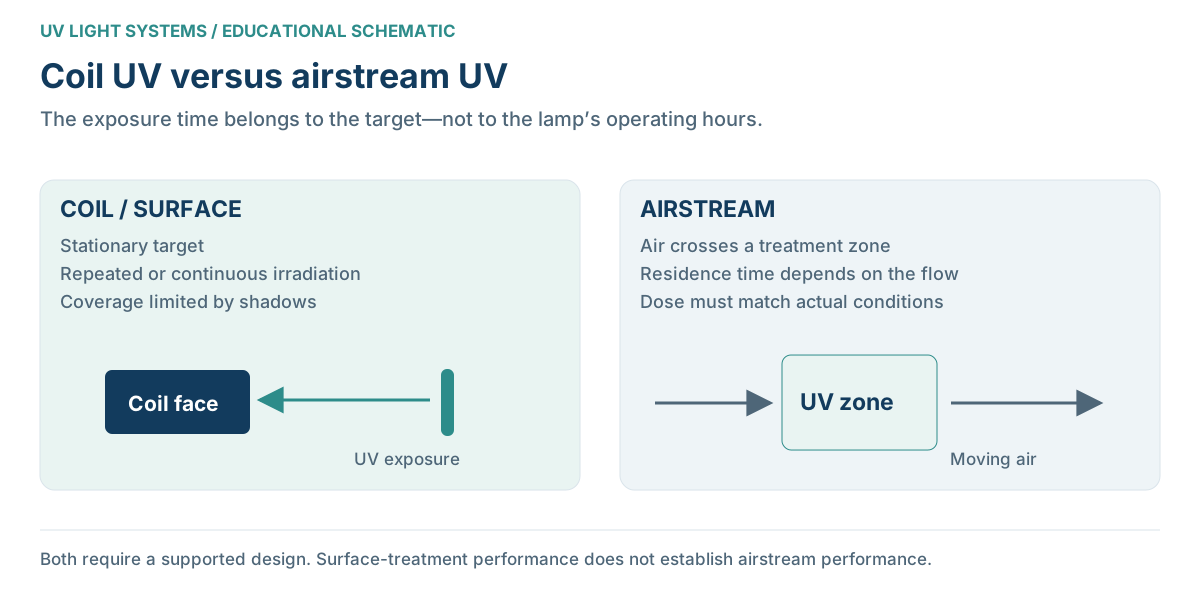
| Design factor | Coil/surface irradiation | Airstream treatment |
|---|---|---|
| Target | Stationary exposed equipment surface | Organisms carried through the treatment zone |
| Exposure time | Repeated or continuous exposure can accumulate | Limited by air path and residence time |
| Air velocity | Can affect lamp conditions; surface remains fixed | Directly affects time in the exposure zone |
| Lamp arrangement | Coverage of the intended surface | Radiation across the intended flow paths |
| Evidence to request | Surface-treatment design and relevant coil findings | Tested performance at matching flow and operating conditions |
Why intensity alone does not settle the comparison
Higher lamp output does not remove a shadow or guarantee uniform exposure across a duct. Airstream systems must account for the least-treated flow paths as well as nominal output. A coil system needs coverage of its specified target, not simply a bright lamp near the cabinet.
Temperature, air movement, deposits and lamp condition can affect the installation. Compare complete-system performance rather than counting lamps or equating electrical power with delivered dose.
Interpret the evidence in its proper setting
ASHRAE engineering guidance recognizes both air and surface applications. Surface-control claims are relatively direct when the outcome is growth on the exposed coil. A claim about airborne treatment needs evidence for the flow and exposure conditions; a claim about household health requires further evidence beyond either device result.
EPA’s cautions about typical residential UVGI units should not be read as contradicting engineered UV applications. They address the limits of generalized home-device claims. Keep the system, setting and outcome attached to the evidence.
Choose the scope that fits the concern
Recurring coil growth calls for assessment of moisture, cleaning and a reachable surface target. Airborne-particle concerns call for appropriate filtration and source control. A documented airstream disinfection objective requires its own design—not a coil lamp relabeled as an air sanitizer.
Read what the evidence supports and the placement guide before comparing proposals.
Costs and maintenance remain application-specific
Airstream and surface systems can differ in lamp configuration, controls and service requirements. Comparing only the device price hides those differences. Ask for the parts, expected operating schedule and commissioning scope needed for the stated objective.
Both need suitable enclosure and safe access. Follow replacement requirements even when a lamp still glows, and never bypass protective controls to demonstrate operation.
From understanding to choosing
If UV fits the goal described here, use the HVAC UV light buying guide to compare documented specifications, installation needs and ownership costs. Keep the treatment objective and operating limits established in this guide as the basis for that comparison.
Questions People Ask Next
Does a coil lamp treat some passing air?
It may expose passing air, but exposure alone does not establish a supported air-disinfection performance level. The design must provide sufficient dose at the relevant airflow. Do not assign an airstream claim merely because the lamp sits inside moving air.
Are airstream systems always more powerful?
They often face a shorter exposure window, but electrical power alone is not a valid category test. Geometry, distribution, lamp conditions and airflow matter. Compare documented performance for the intended target rather than assuming a wattage threshold separates the two.
Does slower airflow always solve inadequate treatment?
Changing airflow can affect the HVAC system and is not a DIY UV adjustment. The treatment and HVAC operating conditions must be compatible. Use a supported design at the required airflow rather than altering the blower to compensate for an unsuitable lamp arrangement.
Which has stronger evidence?
That depends on the claimed outcome. Coil-surface control is a defined equipment application; engineered air treatment also has a technical basis. Neither automatically proves a particular residential health benefit. Evaluate the evidence for the specific configuration and outcome, not a universal category winner.
Can one installation do both?
Only if its supported design and evidence cover both objectives under the actual conditions. A combined claim should identify surface coverage and airstream performance separately. Otherwise describe the installation by the task it is documented to perform.
Sources & further reading
Primary references for the principles discussed. Manufacturer instructions take precedence for a specific system; no independent technical reviewer is claimed.