Start with the indoor cooling coil
The evaporator coil is the indoor heat exchanger where cooling removes moisture from the air. That makes the coil and its drainage area relevant places to inspect when moisture-related growth is suspected. A UV proposal should identify the actual target and explain how the lamp reaches it.
Central split systems, packaged units and compact ductless equipment have different layouts. Do not transfer a mounting plan from one type to another. For a compact or inaccessible indoor unit, obtain specific manufacturer guidance before considering an accessory.
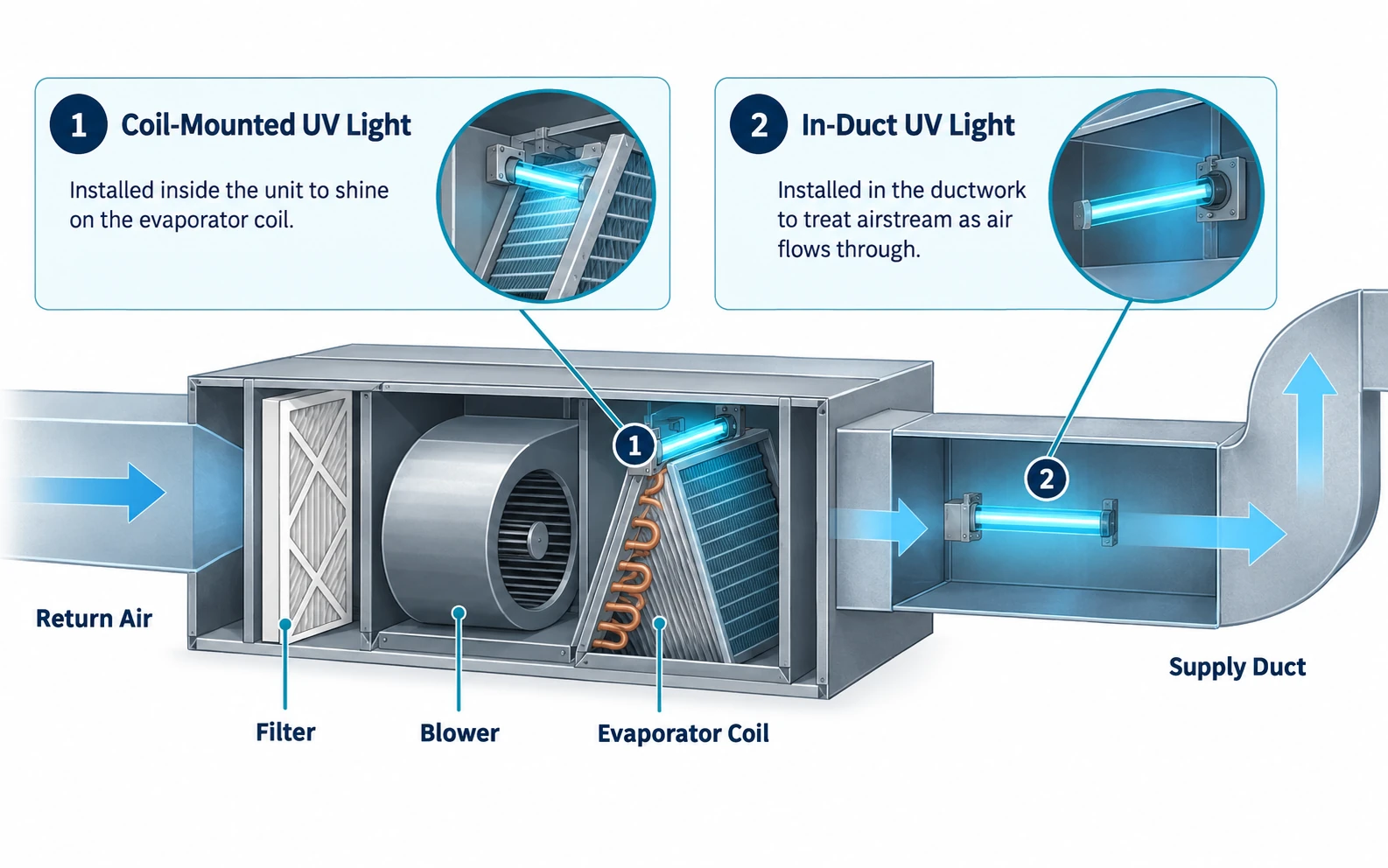
Placement is about coverage and compatibility
Positioning should account for coil dimensions, shadows, nearby wiring and service access. A single lamp may not irradiate all surfaces of a complex coil. The equipment manufacturer’s required clearance takes precedence over generic diagrams.
The installer should check whether plastics, insulation and other exposed materials are suitable for the expected UV exposure. Shielding may be needed. The lamp must be enclosed so occupants and service personnel are not exposed during normal use.
What to fix before adding a lamp
- Assess dirty coils and restricted airflow.
- Check condensate drainage and standing water.
- Investigate recurring growth rather than assuming the lamp will remove it.
- Confirm the filter is appropriate for the system and properly fitted.
Treat these as separate service questions. A proposal that combines cleaning and UV installation should itemize both, so you can understand which work addresses the current problem and which is intended for ongoing control.
Compare the installation and continuing costs
Ask whether the quote includes a lamp, controller, mounting hardware, electrical work and commissioning. Record the replacement-lamp part number and current local replacement quote. The cost guide explains how to compare recurring costs without relying on an unsupported national average.
Plan for service access: a location that is convenient during installation may be difficult to reach after the cabinet is closed or nearby equipment is fitted. Review installation planning and lamp maintenance together.
Understand the coil before selecting a lamp
Review how UV treats an evaporator coil and the HVAC placement examples before evaluating a retrofit. A humid cooling season can make coil condition relevant without establishing that every AC needs UV. Use the value checklist to decide which work deserves priority.
Choosing a UV System: What Actually Matters
After resolving this page’s technical question, compare the following requirements for your installation. The HVAC buying guide brings the full specification record together.
| Criterion | What to verify |
|---|---|
| Application and location | Identify coil irradiation, moving-air treatment or a documented combined design. Mark the actual target and mounting location. |
| Coverage and performance evidence | Compare coil dimensions and cabinet geometry; for moving air, require evidence at the intended airflow and exposure conditions. |
| Materials and ozone characteristics | Review shielding, component compatibility and model-specific ozone/emissions documentation. |
Questions People Ask Next
Will UV make my AC more efficient?
Do not assume a specific energy saving. Coil condition can affect system performance, but the effect of adding UV depends on the starting condition, installation and maintenance. Ask for evidence relevant to the proposed equipment and distinguish a clean-coil benefit from a guaranteed reduction in your utility bill.
Can a UV light remove an AC odor?
Not reliably without identifying the odor source. Drainage problems, accumulated material and sources outside the HVAC equipment need different remedies. A lamp does not remove all odor-producing substances. Have the system inspected before purchasing UV on the basis of an odor complaint alone, and avoid products that substitute an ozone smell for evidence of treatment.
Where does the light go in a split system?
For a coil-treatment application, it is associated with the indoor evaporator-coil enclosure. The exact orientation depends on the equipment geometry and the UV manufacturer’s instructions. The outdoor condenser is not interchangeable with the indoor coil. A technician should identify the target before selecting an installation point.
Is an AC UV lamp better than a HEPA air cleaner?
They do different work. A coil lamp targets irradiated surfaces; a suitable particle air cleaner captures particles moving through its filter. Compare solutions against the actual concern, such as coil growth or airborne dust. Do not add a restrictive filter to central equipment without confirming airflow compatibility.
Can I install it myself?
Use a qualified professional when the work involves electrical connections, cutting into equipment or assessing material compatibility. A generic guide cannot establish a safe mounting point for your system. Follow the product and HVAC equipment instructions, and never energize an unshielded lamp to check whether it looks bright.
Sources & further reading
Primary references for the principles discussed. Manufacturer instructions take precedence for a specific system; no independent technical reviewer is claimed.