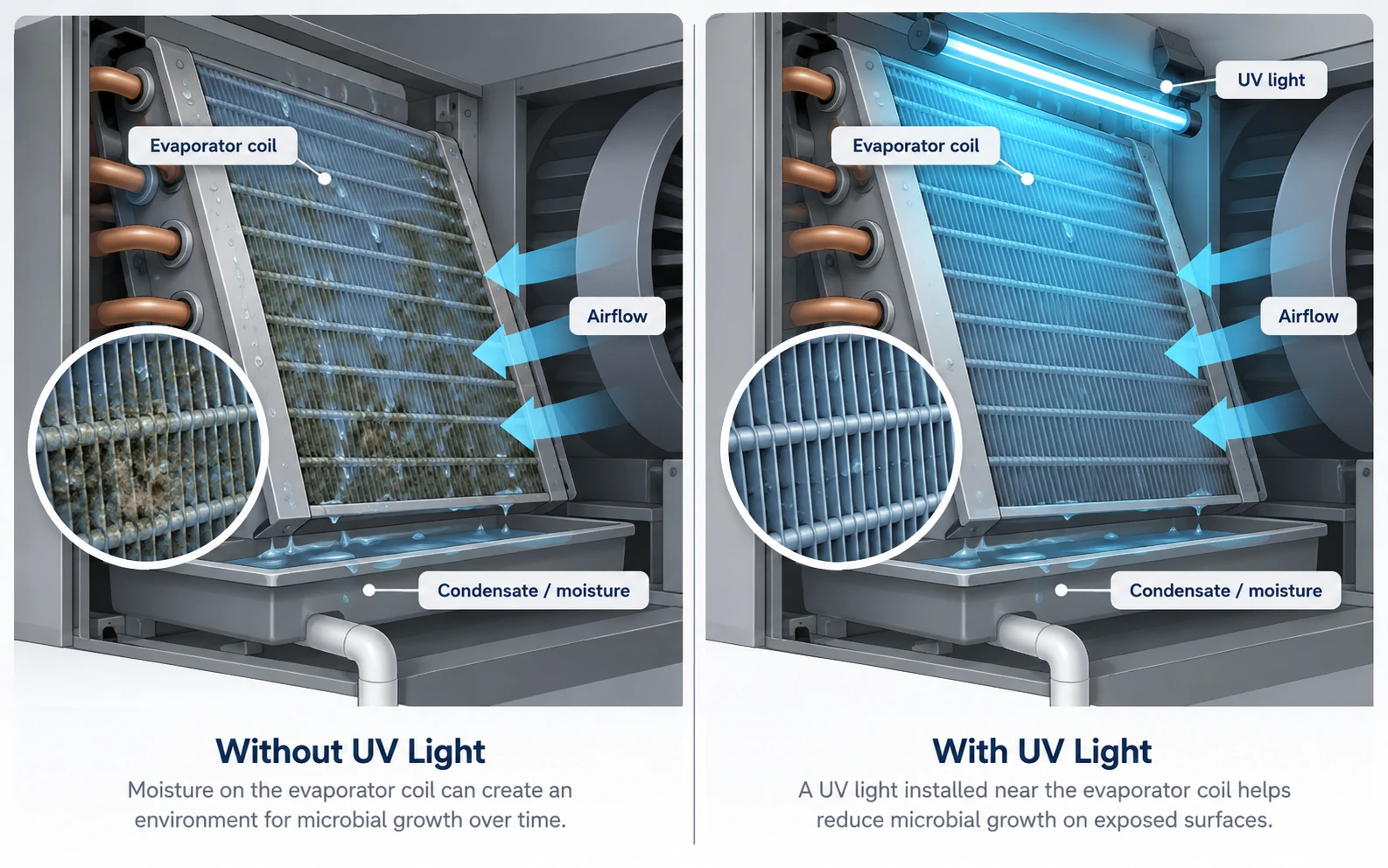
Why HVAC coils are a distinct application
A fixed surface can be irradiated in a controlled location over time. That is a different situation from briefly exposing a room or treating microorganisms in rapidly moving air. A coil installation still needs suitable coverage, output and maintenance.
The supplied illustration is conceptual. UV does not strip deposits off fins or wash away material. The clean appearance shown is not a before-and-after performance claim for any particular lamp.
Intensity, distance and time affect exposure
| Factor | Practical meaning |
|---|---|
| Intensity at the target | Lamp specifications alone do not show what reaches every surface |
| Distance and obstructions | Geometry changes exposure and can create untreated shadows |
| Duration | A longer exposure is not interchangeable with an unspecified dose |
| Organism and surface condition | Susceptibility and shielding can vary |
| System maintenance | Output and cleanliness must remain within the intended conditions |
Inactivation is not remediation
A complete response to a mold problem addresses moisture and affected material. Inactivating an organism does not remove the material or establish that the environment is acceptable for an occupant. EPA notes that dead mold spores can still produce allergic reactions.
For widespread, hidden or recurring problems, use appropriate professional assessment rather than attempting open-lamp treatment. Do not expose people or pets to UV while trying to treat surfaces.
Use a practical decision sequence
- Locate the moisture source and affected material.
- Determine what cleaning, removal or repair is needed.
- If considering HVAC UV, define the specific surface target.
- Verify compatible placement and an ongoing maintenance plan.
- Evaluate the remaining problem after the underlying work—not merely whether the lamp turns on.
Questions People Ask Next
How long does UV take to kill mold?
There is no reliable universal time. Dose at the target, wavelength, organism, surface condition and geometry all matter. A duration without those conditions does not establish effectiveness. Follow a validated, application-specific design; do not extend exposure arbitrarily or operate an unshielded lamp as a substitute for moisture correction and remediation.
Can UV reach mold behind drywall?
Do not assume that UV applied from outside a wall reaches hidden growth. Obstructions and building materials prevent a room lamp from treating enclosed contamination. A hidden-moisture problem requires investigation of the source and affected materials. Installing a lamp in HVAC equipment does not change that limitation.
Does sunlight solve an indoor mold problem?
Sunlight is not a controlled remediation method for hidden or established indoor contamination. Exposure is uneven and does not address the moisture source or remove affected material. Do not use it as evidence that a room or object is safe. Base the response on the actual condition and appropriate cleanup guidance.
Is killing mold enough?
No. Inactivation and removal are different outcomes. Mold material can remain after treatment, and the moisture that supported growth can continue. A response should address those issues rather than treating a “kill” claim as a complete solution. Seek suitable assessment for extensive, recurring or concealed contamination.
Should I replace my filter after finding mold?
Follow the equipment instructions and the recommendations from the contamination assessment. A filter is only one part of the system, and replacing it does not repair moisture problems or clean other affected components. Avoid treating a single maintenance action as proof that a broader mold issue has been resolved.
Sources & further reading
Primary references for the principles discussed. Manufacturer instructions take precedence for a specific system; no independent technical reviewer is claimed.