Identify the furnace, coil and ductwork
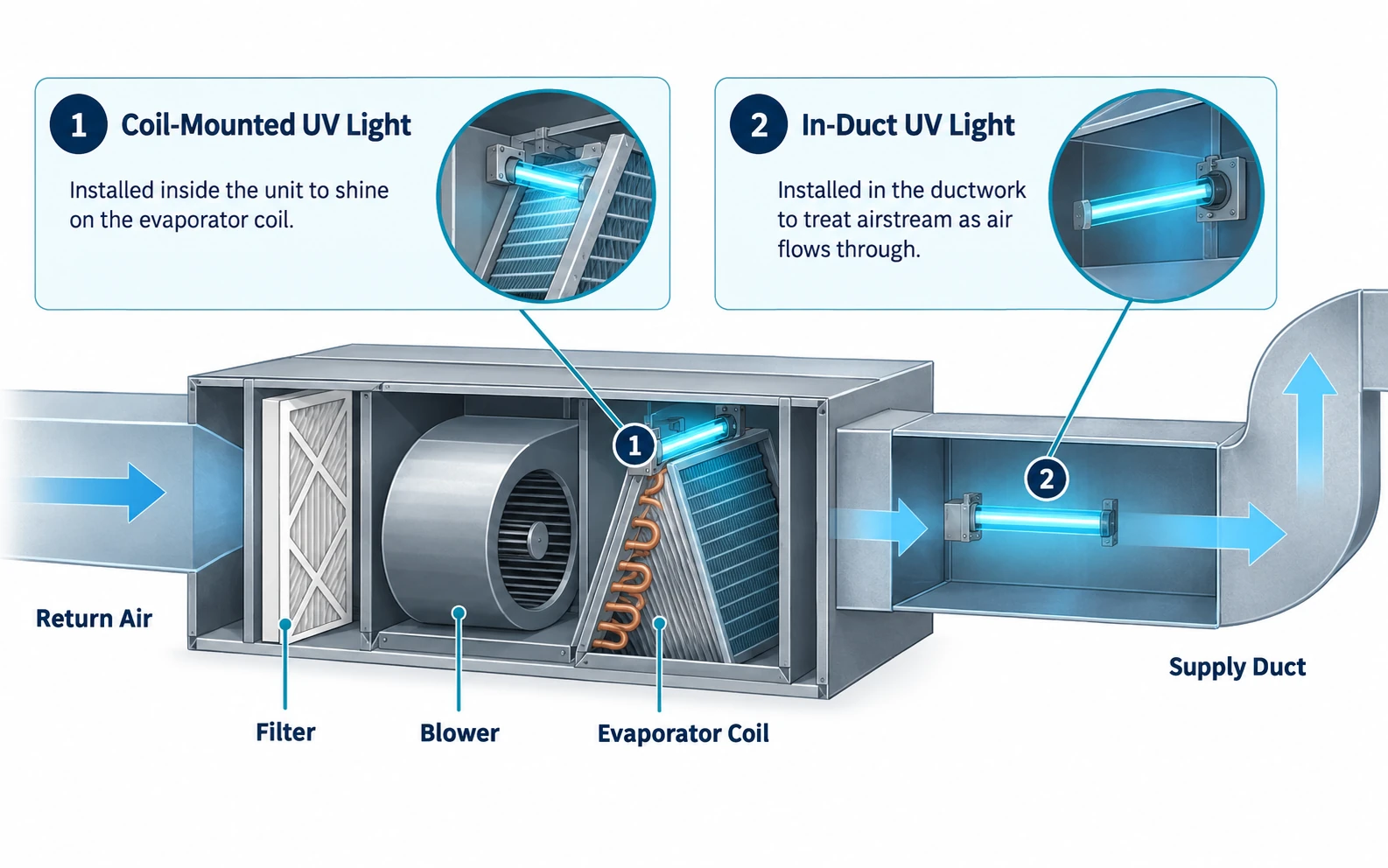
A central system may combine a furnace blower with an attached cooling-coil cabinet. The layout varies with equipment orientation. Ask the installer to point out each section and identify the exact UV treatment target on your equipment.
If there is no cooling coil, a coil-treatment rationale may not apply. An airstream proposal still needs its own engineering basis; adding a lamp to available duct space is not the same as specifying a supported air-treatment system.
Keep the heating system’s requirements central
Mounting must preserve access to the furnace and its service panels. Do not modify a combustion chamber, venting arrangement or protective control as part of a generic UV retrofit. Clearances and accessories must be acceptable for the equipment.
A professional should evaluate the environment in the proposed location, including the temperature range stated for the lamp and controller. A lamp suitable for one part of a cooling system may not be suitable for every section connected to a furnace.
Ask for a proposal with a defined scope
- What is the UV target: cooling-coil surface or moving air?
- Which manufacturer instructions permit the proposed location?
- How will vulnerable materials and people be protected?
- Where will the power supply connect, and who will perform that work?
- Can the lamp be removed without obstructing normal furnace service?
Review the installation sequence before comparing contractors. A quote should separate furnace repairs, coil cleaning and the UV accessory so that unrelated work is not hidden in a single price.
Account for seasonal use and maintenance
A combined heating-and-cooling system operates under changing conditions. Confirm the intended lamp operating schedule and whether the controller is designed for the proposed service environment. Do not infer an on/off schedule solely from whether the furnace is heating.
Keep UV maintenance records with the HVAC documentation. Replacing a UV lamp is separate from inspecting burners, heat exchangers, filters and venting. A UV service visit should not be represented as a complete furnace safety inspection.
Follow the treatment path through the system
The HVAC UV mechanism guide separates airflow from surface exposure. A proposed return- or supply-side position must also satisfy the placement and clearance checks. Keep the HVAC filter’s particle-capture role separate from the UV accessory.
Choosing a UV System: What Actually Matters
After resolving this page’s technical question, compare the following requirements for your installation. The HVAC buying guide brings the full specification record together.
| Criterion | What to verify |
|---|---|
| Application and location | Identify coil irradiation, moving-air treatment or a documented combined design. Mark the actual target and mounting location. |
| Wattage and electrical supply | Check complete-system input, required voltage, ballast/controller and the proposed power source with the installer. |
| Materials and ozone characteristics | Review shielding, component compatibility and model-specific ozone/emissions documentation. |
Questions People Ask Next
Will a furnace UV light treat carbon monoxide?
No. UV is not a control for carbon monoxide or a repair for combustion and venting faults. Follow the furnace manufacturer’s safety instructions and maintain appropriate carbon-monoxide alarms. Treat a suspected combustion problem as a separate safety issue requiring qualified assessment, regardless of whether the system has a UV accessory.
Does every furnace have an evaporator coil?
No. A cooling coil may be attached when the furnace is part of a combined central cooling system, but furnace-only arrangements also exist. The presence and location of that coil must be confirmed. A salesperson’s use of the phrase “furnace UV light” does not establish which component will be treated.
Should the lamp be in the return or supply duct?
There is no universal answer. The location must match the treatment objective, supported system design, available exposure zone and equipment requirements. Ask why the proposed location is appropriate at your airflow and operating conditions. A diagram is useful for understanding the options but cannot determine the correct position for every furnace.
Can I use any replacement UV bulb?
No. Match the specified lamp, connector, controller and electrical characteristics. A lamp that physically fits may not have the required output or compatible operating characteristics. Keep the original part number and confirm manufacturer-supported substitutions before purchasing. The replacement-lamp guide includes a checklist for documenting the correct part.
Will it reduce dust in my home?
A UV lamp does not collect dust. If dust is the concern, investigate sources, filter fit, suitable filtration and cleaning. The furnace blower may circulate air through both a filter and a UV treatment zone, but those components serve different purposes. Neither should be described as replacing all other indoor-air-quality measures.
Sources & further reading
Primary references for the principles discussed. Manufacturer instructions take precedence for a specific system; no independent technical reviewer is claimed.