UV light systems.
For HVAC, water
& indoor air quality.
UVLightSystems.com is an independent educational resource covering UV-C systems for HVAC, water treatment, air quality and related applications. Understand where UV helps and where other treatment is needed.
Independent education · Evidence-informed guidance · Clear benefits and limitations
What is a UV light system?
A UV light system applies ultraviolet energy to a defined treatment area. In HVAC and water systems, UV-C can inactivate susceptible microorganisms under appropriate conditions. It is one part of a treatment strategy—not a replacement for filtration, cleaning or maintenance.
Choosing the Right UV System
Choosing a UV system requires more than comparing price or lamp wattage. Application, placement, UV dose, flow rate, replacement costs, monitoring, maintenance and certification can all affect whether a system is appropriate.
Different systems.
Different jobs.
Start with the application. The right questions for a cooling coil are different from those for a drinking-water supply.
HVAC UV Systems
Coil treatment, duct placement and choosing a system that fits.
Explore guides 02 / WATER SYSTEMSWater Treatment
Well water, whole-house systems and essential pretreatment.
Explore guides 03 / INDOOR ENVIRONMENTSMold & Air Quality
What UV can control—and what needs a different solution.
Explore guides 04 / SYSTEM OWNERSHIPInstallation & Maintenance
Plan the installation and keep the system operating as intended.
Explore guides 05 / TREATMENT CHOICESTechnology Comparisons
Compare UV with filtration, reverse osmosis, chlorine and air cleaners.
Explore guides 06 / SAFE OPERATIONSafety
Understand exposure, ozone and treatment-fault precautions.
Explore guidesHow UV light systems work
Reach the target
A lamp delivers UV into an enclosed chamber, onto a coil or into an engineered air-treatment zone.
Allow enough exposure
Intensity, exposure time, distance and operating conditions affect the dose reaching microorganisms.
Treat, then maintain
UV does not collect particles or remove dissolved chemicals. Filtration and routine service still matter.
A small lamp.
A specific purpose.
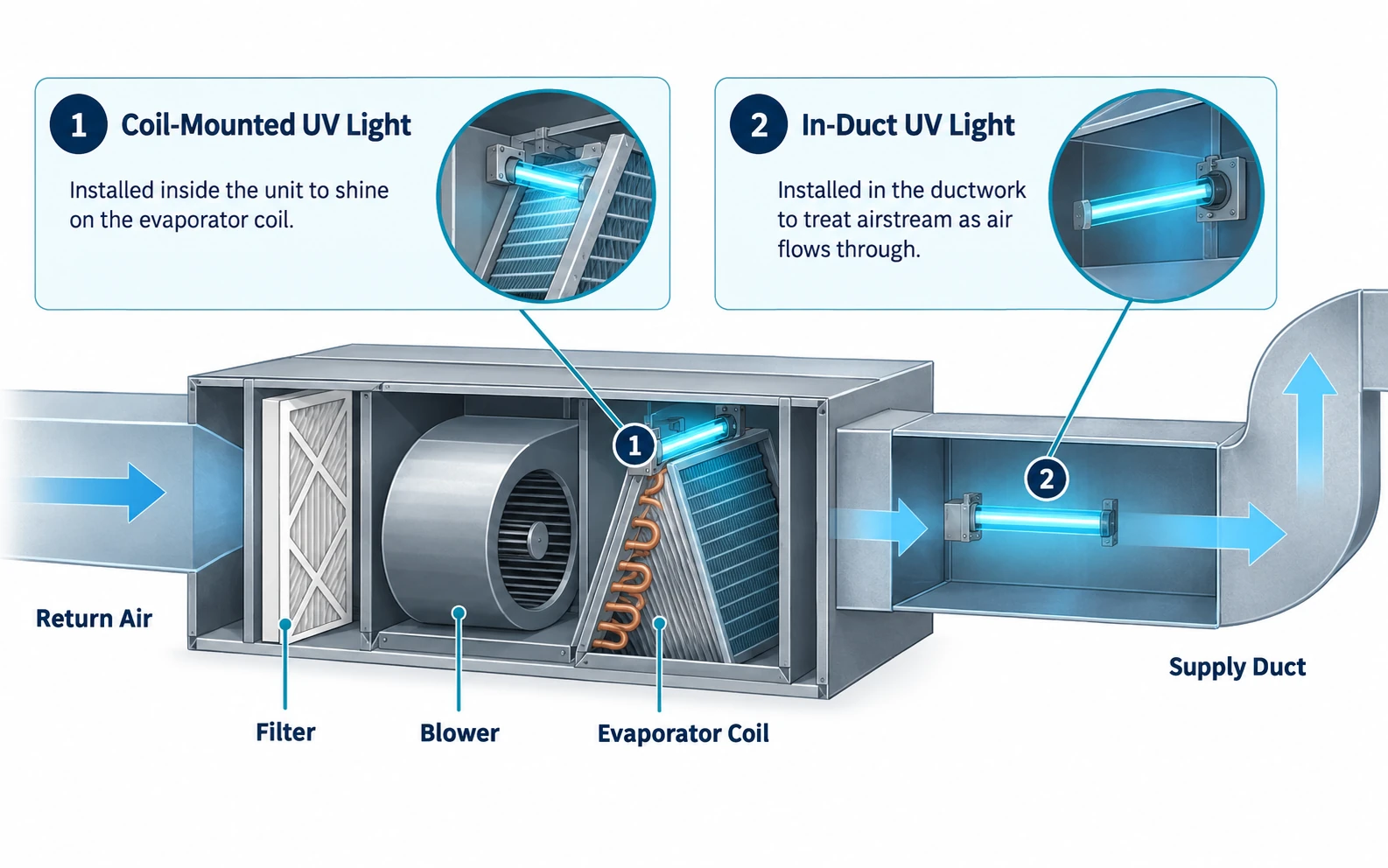
Coil-mounted lamps target exposed, damp surfaces. Airstream systems have a different design challenge: treating air while it moves.
Understand HVAC UV systems →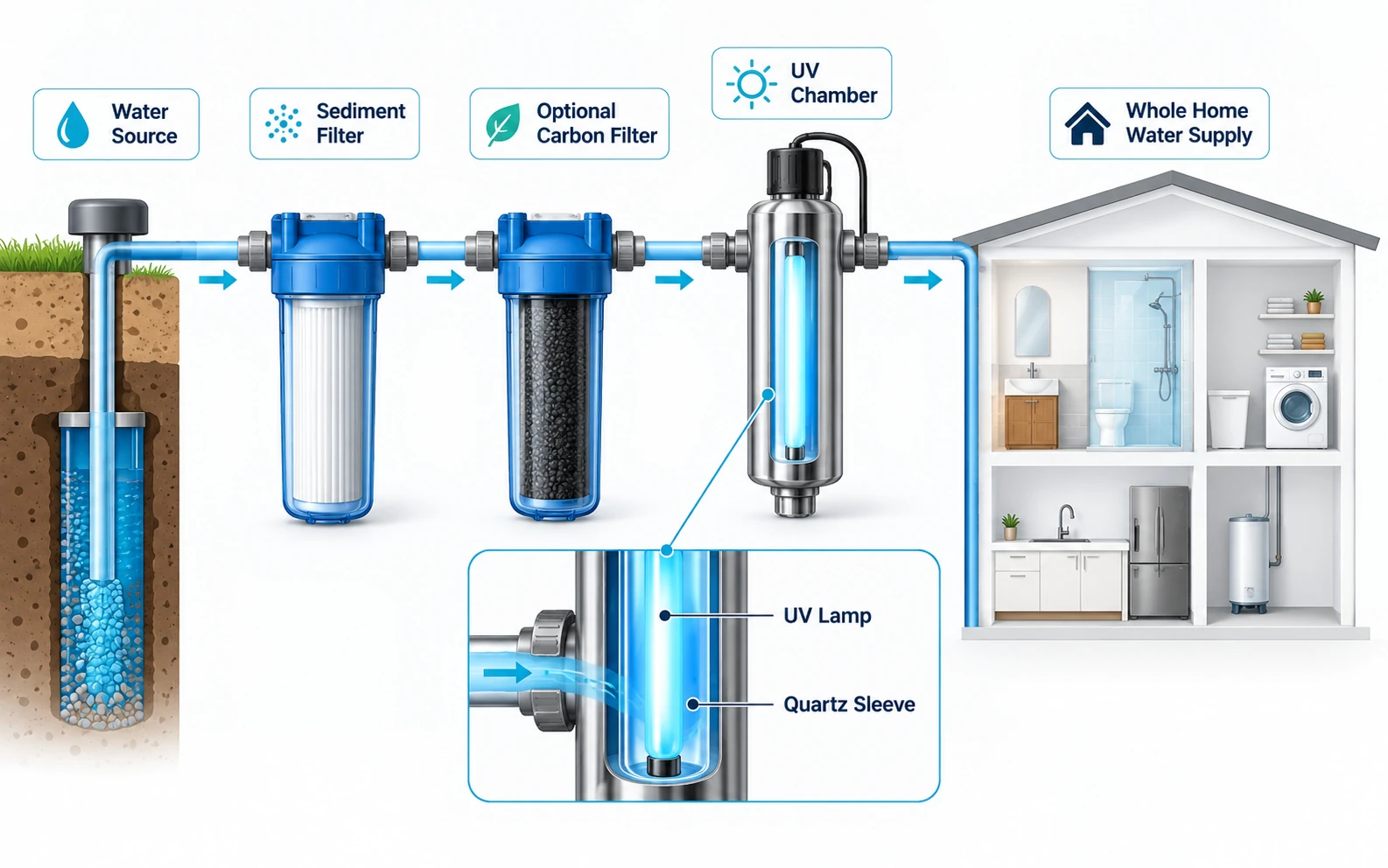
Water quality comes
before the UV chamber.
Start with a water test. Match pretreatment and flow rate to the UV system, then plan for lamp replacement, alarms and power interruptions.
Explore UV water treatment →Popular guides
UV light and HVAC mold
Understand exposed surfaces, moisture and the limits of UV.
Read the guideWhat goes into the cost?
Compare equipment, installation and ongoing ownership.
Read the guideHow to choose an HVAC UV light
A buying framework built around evidence and compatibility.
Read the guidePlan an HVAC UV installation
Assessment, placement, electrical work and commissioning.
Read the guideReplacement lamps & maintenance
Why a glowing lamp may still need replacement.
Read the guideUV safety and ozone
Learn about shielding, exposure and product claims.
Read the guideWhat UV can and cannot do
UV can reduce or inactivate susceptible microorganisms when an appropriate dose reaches the target. It does not remove dust, allergen-containing particles, dissolved chemicals or minerals, and it should not automatically replace filtration or other treatment.
| Technology | Primary purpose | Important limitation |
|---|---|---|
| UV-C treatment | Inactivate susceptible microorganisms receiving an adequate dose | Does not physically collect dust, pollen or mold debris |
| Particle filtration | Capture particles passing through the filter | Performance depends on filter fit, efficiency and airflow |
| Water filtration / reverse osmosis | Reduce specified contaminants using suitable treatment media | Check the actual contaminant-reduction certification |
Questions People Ask Next
Are all UV light systems the same?
No. A coil-treatment lamp, an air-disinfection installation and a water reactor serve different purposes. Evaluate the complete system and the conditions under which performance was measured. Lamp wattage alone does not establish whether a product fits your application. Start with the HVAC or water hub for the relevant selection questions.
Does UV replace a filter?
No. UV treatment and filtration have different roles. Filtration captures or separates specified contaminants; UV delivers radiation to susceptible microorganisms. A combined approach may be appropriate, but neither technology removes every contaminant. The comparison guide explains why choosing between them starts with the problem you want to address.
Can UV light solve a mold problem?
UV may help control growth on directly irradiated HVAC surfaces, but a mold problem still requires attention to moisture and affected materials. It will not treat hidden wall cavities or remove mold debris. Read the mold guide before treating a lamp as an alternative to cleaning or remediation.
How should I compare costs?
Ask for an itemized equipment-and-installation quote, then add replacement lamps, filters where applicable, service and electricity over the same ownership period. Compare systems designed for the same task. A cheaper coil lamp and a larger airstream installation are not equivalent purchases; our cost guide provides a worksheet.
Where should I start if I use well water?
Start with testing through an appropriate laboratory and advice from your local drinking-water authority. Choose treatment for the contaminants found, then check the UV equipment’s water-quality and peak-flow requirements. UV is not a universal solution for chemical contamination. The well-water guide helps organize the questions for a treatment professional.
Sources behind the fundamentals
Explore the EPA guide to home air cleaners, CDC overview of home water treatment and our editorial methodology. Detailed guides include application-specific references.